Table of Contents
Sustainable Food Production Through Vermicomposting | Report

Authors:
- Ana Mendes
- Elena Victoria Tatuc
- Fien Joos
- Jakub Wyka
- Kris Petrevski
Acknowledgements
The team deeply thanks Instituto Superior de Engenharia do Porto (ISEP) for providing their facilities during this semester. Furthermore, the team expresses their gratitude to the ISEP and European Project Semester (EPS) organizers and teachers who provided us with this enriching experience to be involved in a challenging project that allows us to grow personally and professionally.
Glossary
| Abbreviation | Description |
|---|---|
| B2B | Business to Business |
| B2C | Business to Customer |
| C-U | Control-Unit |
| EMC | Electromagnetic Compatibility |
| EPS | European Project Semester |
| EU | European Union |
| EUIPO | European Union Intellectual Property Office |
| FAQ | Frequently Asked Questions |
| GHG | Greenhouse Gas |
| IoT | Internet of Things |
| ISEP | Instituto Superior de Engenharia do Porto |
| LAN | Local Area Network |
| LCA | Life Cycle Assessment |
| LVD | Low Voltage Directive |
| OE | Order of Engineers |
| PBI | Project Backlog Item |
| PDCA | Plan-Do-Check-Act |
| PFC | Perfect Fit Client |
| PSS | Product Service System |
| RED | Radio Equipment Directive |
| RFID | Radio-frequency Identification |
| ROHS | Restriction of Hazardous Substances |
| SDS | Serve Don't Sell |
| SEO | Search Engine Optimization |
| SWOT | Strengths Weaknesses Opportunities Threats |
| USB | Universal Serial Bus |
| WBS | Work Breakdown Structure |
1. Introduction
EPS is a one-semester program offered by different universities throughout Europe, including ISEP. The main idea of the program is to provide students with the experience of working together in an interdisciplinary and international team of three to six students and hopes to foster the kind of team-working skills sought after by employers. The goal is to design and develop a new product by combining each other’s knowledge and skills. In this first chapter of the report, the members of our team are presented, and the topic of the project is elaborated.
1.1 Presentation
This team, which is part of the European Project Semester at Instituto Superior de Engenharia do Porto during the spring semester of 2021, consists of five students from different countries and fields of study. These students combined their knowledge and skills to work together towards the same goal, which is stimulating sustainable food production by designing a smart vermiponics system for city buildings.
Our scientific backgrounds are shown below in Table 1.
| Name | Country | Field of study |
|---|---|---|
| Ana Mendes | Portugal | Biomedical Engineering |
| Elena Victoria Tatuc | Romania | Industrial Design |
| Fien Joos | Belgium | Product Development |
| Jakub Wyka | Poland | Mechanical Engineering and Applied Computer Science |
| Kris Petrevski | Macedonia | Information and Communication Sciences for Business and Management |
Team 2 is presented in Figure 1, during an online meeting.
1.2 Motivation
The team members of team 2 have chosen to participate in the EPS program because of multiple reasons. First of all, we are all keen to gain new experiences and to broaden our horizons by stepping out of our comfort zone and take on this new challenge. Secondly, we want to explore new academic fields and new cultures, and working together in an international and multidisciplinary team is a great opportunity to do this and to learn from each other. Next, the scientific, as well as social aspects of the project appeal to us. Finally, we aim to improve our English as well as learn to look at the design process from different points of view.
We believe that participating in the EPS program will be enriching in many ways. We want to develop a project that inspires and connects the members of our team. The vermiponics system is an interesting topic, as it can contribute to a more sustainable environment, which is an urgent need in today’s society.
1.3 Problem
As the world’s population grows, the demands for increased food production expand, and as the stresses on resources such as land, water and nutrients become ever greater, there is an urgent need to find alternative, sustainable and reliable methods to provide this food. The current strategies for supplying more produce are neither ecologically sound nor address the issues of the circular economy of reducing waste [1].
Food production relies on the availability of resources, such as land, freshwater, fossil energy, and nutrients, and current consumption or degradation of these resources exceeds their global regeneration rate. The concept of planetary boundaries aims to define the environmental limits within which humanity can safely operate concerning scarce resources.
As reflected in the UN’s Sustainable Development Goal 2, one of the greatest challenges facing the world is how to ensure that a growing global population, projected to rise to around 10 billion by 2050, will be able to meet its nutritional needs. To feed an additional two billion people by 2050, food production will need to increase by 50 % globally. Whilst more food will need to be produced, there is a shrinking rural labour force because of increasing urbanization. At the same time, food production will inevitably face other challenges, such as climate change, pollution, loss of biodiversity, loss of pollinators, and degradation of arable lands. These conditions require the adoption of rapid technological advances, more efficient and sustainable production methods, and more efficient and sustainable food supply chains.
In short, the global population is rapidly growing, urbanizing, and becoming wealthier. Consequently, dietary patterns are also changing, thus creating greater demands for greenhouse gas (GHG) intensive foods, such as meat and dairy products, with correspondingly greater land and resource requirements. But whilst global consumption is growing, the world’s available resources, i.e. land, water, and minerals, remain finite. Thus, a major global challenge is to shift the growth-based economic model towards a balanced eco-economic paradigm that replaces infinite growth with sustainable development.
In this context, aquaponics has been identified as a farming approach that, through nutrient and waste recycling, can aid in addressing both planetary boundaries and sustainable development goals, particularly for arid regions or areas with non-arable soils. Aquaponics is also proposed as a solution for using marginal lands in urban areas for food production closer to markets. Whilst aquaponics may be considered in the mid-stage of development, there are several allied, novel methods of food production that are aligning alongside aquaponics, and which can be merged with aquaponics to deliver food efficiently and productively. These technologies include algaeponics, aeroponics, aeroaquaponics, maraponics, haloponics, biofloc technology, and vermiponics.
Additionally, there is another aspect to be considered regarding food - food waste. This is a global issue, and only in the European Union (EU), around 88 million tonnes of food are wasted annually, consequently generating costs of 143 billion euros. Food waste is an ethical and economic issue, but it also depletes the environment of limited natural resources. It is estimated that food waste generates eight per cent of Global Greenhouse Gas Emissions. The food wasted should be distributed to the 33 million people in the EU suffering from hunger and malnutrition [2]. Most of the food waste ends up in landfills, making up more than 50 per cent of global landfill waste [3]. This value could be reduced through better use of the organic food waste generated, as it can be composted to form organic fertilisers.
In our project, the focus will be on vermiponics, which uses worm casts of mainly red wriggler worms also known as tiger worms (Eisenia fetida or E. foetida) to provide nutrients in a hydroponic system. Allied to the vermicomposting, we will include a 'keyhole garden' design in our product. It should be noted that vermiponics is in its infancy and mainly practised by hobbyists and in research laboratories. Therefore, it is interesting to explore the possibilities of vermiponics.
1.4 Objectives
The main objective of this project is to develop a modular vermiponics system for residents of a city building. This objective involves designing the product and building and testing a prototype. In the designing phase, our main concerns will be related to the modularity of the system and the smartification of the vermiponics. Sustainable production techniques are already considered during the design phase. Concerning the building phase, a list of materials will be needed and close attention will be paid to assembling the components to secure the relationship between every layer of the vermiponics (the water, the worms, and the plants). Finally, testing the product is essential. Our objective of this phase is to have a working prototype and see actual results.
1.5 Requirements
The requirements of the project include:
- Mandatory adoption of the International System of Units;
- Using open-source software and technologies;
- A maximum budget of 100 €.
Functional requirements:
- Modularity (multiple configurations possible/ multiple sizes,…);
- Low energy consumption (even without any source of energy the system must be able to operate);
- Easy installation and maintenance (design for assembly and disassembly);
- Recyclable components.
Standard requirements:
Comply with the following EU Directives:
- Machine Directive (2006/42/CE 2006-05-17);
- Electromagnetic Compatibility Directive (2004/108/EC 2004 12 15);
- Low Voltage Directive (2014/35/EU 2016-04-20);
- Radio Equipment Directive (2014/53/EU 2014-04-16);
- Restriction of Hazardous Substances (ROHS) in Electrical and Electronic Equipment Directive (2002/95/EC 2003-01-27).
1.6 Envisaged Tests
A set of functional and performance tests are required to verify the operation of the system. These tests are described in table 2.
| Condition | Expected result |
|---|---|
| Temperature and humidity sensor to ensure an optimal environment for the eco-system. | Microcontroller processes the information from both sensors and notifies the user when any adjustments need to be made. |
| Time-of-flight sensors to track the movements of the worms. | Microcontroller processes the information from the sensor and provides information about the position of the worms. |
| IoT platform communication. | The online platform receives values from the microcontroller. |
| Mobile application displaying information. | The app displays the information according to the data sent by the microcontroller. |
1.7 Report Structure
The following table contains the main eight chapters of the report, with a small description of each of them.
| Title | Description | |
|---|---|---|
| 1 | Introduction | Presentation of the team members, of the project purpose,objectives and requirements. |
| 2 | State of the art | Identification of previous knowledge about smart products. |
| 3 | Project management | Overview of the progress in the Agile management and SCRUM. |
| 4 | Marketing plan | Identify the main target group and strategies to introduce our product in the market. |
| 5 | Eco-efficiency Measures for Sustainability | Measures to implement to make the product as sustainable as possible. |
| 6 | Ethical and Deontological Concerns | Analysis of the ethical challenges related to vermiponics. |
| 7 | Project Development | Next steps to be done in order to build the prototype: concept, architecture, components, materials, prototype. |
| 8 | Conclusions | Summary of our project so far and future work. |
2. State of the Art
2.1 Introduction
The general theme ‘smartification of everyday objects’ was the starting point for this project. Before the actual topic of our project was chosen, a study was made about the history and current market of smart products. By gaining insights into this market segment, a better decision could be made on where to innovate and for which object added value could be created through smartification.
The Fourth Industrial Revolution (Industry 4.0) is the automation of normal manufacturing and industrial practices, using smart technology. This Industry gained an increasing amount of attention over the years, and there has been a significant demand for more complex and technological developments [4].
Hoffman and Novak [5] define smart products as products that “interact and communicate with themselves and each other – and with humans – on an ongoing basis by sending and receiving data through the Internet that is stored and organized in a database.” In summary, smart products have:
- Sensors that collect data about the environment, and answer to a physical or chemical stimulus. They can monitor and react to human or/and environmental behaviour. The most common sensors measure temperature, humidity, movement, light, and sound;
- Actuators that are controlled by a Control-Unit (C-U) and activate an action based on the data collected by the sensors. They usually respond by converting the source's energy into mechanical motion and can be categorized depending on the type of motion they present and
- Network connectivity is the process of connecting different parts of a network. This can be achieved via Wi-Fi, Bluetooth, Radio-Frequency Identification (RFID), Local Area Network (LAN), and others.
The three main features of smart products are intelligence, ubiquity, and autonomy. The smart products market is heterogeneous and has many segments (health, smart home, mobility, lifestyle, etc.) and several economic actors (multinationals such as Google and Apple or new start-ups offering innovative products) [6].
2.1.1 Markets and Contexts
A smart product can be categorized into one or more contexts. The main contexts/categories of these products are:
- Smart cities: dealing with congestion, energy waste, improving quality of life.
- Smart home: control appliances, lights, thermostats, and other devices with network connectivity.
- Health: smart medical devices, monitor and transmit data in real-time, connecting doctors with patients.
- Mobility: a multimodal capability that bundles many transport options.
- Lifestyle: these include smart textiles, gadgets, etc.
2.1.2 Consumers' Resistance
The continuous growth of the Internet of Things (IoT) carries challenges and ethical issues, such as lack of human control, doubts about the utility and added value of the product (perceived uselessness), perceived price, the difficulty of usage, privacy, and security concerns, and perceived novelty. The consumers' resistance manifests itself in three forms - rejection, postponement, or opposition -, and the understanding of these manifestations is important for the success of smart products, reducing the risk of failure [7].
2.2 Research Projects
Tobias Mittag et al. [8] studied the recurring smart services and their implementations for manufacturing companies. The selection of ten case studies allowed them to find out the main features of smart products/services and their implementation. To identify the recurring elements, they did a comparative analysis, selecting the recurring functions of the case studies: Product Monitoring, Analytics, Alerting, Communication, Provide Information. Furthermore, this research enhances the importance of creating an overall solution that meets the requirements of the market as customers expect/demand certain services (Market Pull).
Soumitra Chowdhury et al. [9] did a systematic literature review to answer the question “What are the value-creating features of smart product-service systems in industrial firms?”. A Product Service System (PSS) is an integrated product and service that delivers value for the customers and product manufacturers. Smart PSS refers to the incorporation of smart digital technologies in the design and delivery of PSS.
In 2019, Pai Zheng et al. [10] conducted a study on Smart PSS, its key aspects, challenges, and future perspectives, of which they concluded that their findings could be summarized into three different aspects - Technical aspect, Business aspect, and Social and Environmental aspect.
Muztoba Khan and Thorsten Wuest [11] focused on the importance of upgradable PSS, but this logic can be applied to smart products as well. The shorter innovation and product development cycles make consumers dispose of conventional products before the end of their useful lives, that even if the product was considered sustainable, this life-shortening practice, takes away that aspect. Making a product/system upgradable is the right path to approach this problem because as new technologies for product development arrive, one could still take advantage of those, but with the original product/service they bought.
The following table compiles the most important aspects and features of smart products/services according to the different studies mentioned above.
| Project | Theme | Main Features | Business | Design | Manufacturing | Usage |
|---|---|---|---|---|---|---|
| Building blocks for planning and implementation of smart services based on existing products [12] | Smart products/services and their implementation | Product monitoring Analytics Alerting Communication Provide information | 'Use-oriented' business model | Involvement of users in the process | Building blocks Use available data about the system to keep improving it | Monitoring Optimization Service support |
| Smart Product-Service Systems in Industrial Firms [13] | Smart PSS features for added value | Digital resource integration with customers Connect capability Analytic capability | Use generated data to improve customer relationship and PSS redesign | Boundary spanning Dynamic capabilities | Manufacturers have to find ways to exploit digitalization to meet current needs of the digital era | Remote monitoring to reduce machinery breakdowns |
| A survey of smart product-service systems [14] | Key aspects of PSS | Digitalization capabilities (connect, analytic, intelligence) Co-creation | Business model Digital platform Value co-creation Circular economy | Adaptable design Service innovation | Planning Process control | Remote monitoring Reconfiguration Reuse Remanufacturing Recycling at 'end-of-life' stage |
| Towards a framework to design upgradable product service systems [15] | Importance of upgradable PSS | Customization Modularization | Upgradable systems provide a better and continuous relationship with customers | Flexible design to allow rearrangements during the use phase under the customer's requirements, while maintaining minimal structural change | Integrated development of product and service | Collect data about the usage behaviour and taking customer feedback into account |
From this analysis it is possible to say that monitoring is a common and important usage feature, mentioned in each project, to improve the relationship with the customers. Other key aspects to retain are that this relationship with customers should be open and truthful, as the company should provide information about the design and manufacturing stages, as well as service support during the usage stage. Furthermore, the products should be reusable, and/or recyclable products that add value, and the modularization and customization help to create upgradable services/products for greater longevity.
2.3 Commercial Projects
The commercial projects/products are vital in the comparative process of the first research steps, to oversee what is already available on the market, to analyse the qualities and downsides of the products, and to conclude on which features the team's product should compile, and some issues that could be solved with said product.
The next table contains a smart object/product for each context/market mentioned previously, with its description, main features, market, price, and an evaluation of sustainability (environmental, economic, and social) and ethics.
| Product | Context | Description | Main Features | Sustainability | Ethics | Market | Price (€) |
|---|---|---|---|---|---|---|---|
| Bigbelly | Smart cities | Smart waste and recycling system | Solar-powered Sensor-equipped Real-time communication | Environmentally sustainable | Very respectful of ethical issues | Municipalities and cities governors | Not specified |
| Wi-Fi Plug | Smart home | Intelligent plug | Wi-Fi connection Energy-efficient Measurement of electricity consumption Timer to turn on/off | Environmentally and economically sustainable | No issues reported | Everyone who wishes to keep track of their energy consumption and people who forget | 9.99 - 14.00 |
| 8sense by Beurer | Health | Device that vibrates when back posture is not correct or when the person is in the same position for too long | Real-time feedback 14-day memory “8sense” app Lithium-ion battery | Not very sustainable (materials, production) | Ally to preventive health, avoiding back problems | For everyone who desires to correct their posture/maintain it correct | 100.00 |
| MaaS Made Easy | Mobility | Software for easy access to smart mobility (for transport operators, municipalities, and corporations) | Flexibility Integration Cost-effective Route planner Real-time transit data | Sustainable for the environment, the economy, and the community | Privacy data issues can be found due to vulnerabilities of the system | Everyone can benefit from smart mobility strategies | Not specified |
| Smart Watch | Lifestyle | Sports watch | 12 sports modes GPS Heart rate monitor Acceleration, Geomagnetic, Air pressure, Ambient light sensors Bluetooth 5.0 App 14-day battery life | Unsustainable production, but sustainable for the community to monitor vital signs, exercise, etc. | Can be an ally for preventive health Vulnerabilities of the system can be found (potential threat to users) Misused data will also cause bad influence and the companies are not transparent on the usage of personal data | Suitable for everyone | 25.00 - 450.00 |
2.4 Sustainable Food Production Systems
The demands for increased food production caused by the world’s population growth mentioned in section 1.3 (previous chapter) directed the focus of the project to the urban areas, where 55 % of the world’s population lives currently, and is expected to increase to 68 % by 2050 [16]. After evaluating the existing market of smart products, the theme of the project is sustainable food production systems.
2.4.1 Aquaponics
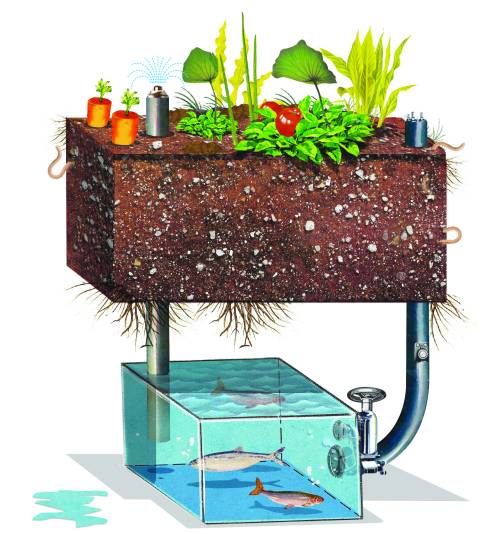
Aquaponics is a food production system. It’s an energy and cost-efficient way to grow plants and vegetables. Aquaponics is based on a system that uses a symbiotic relationship between plants and fish. The main process that occurs in this system is that bacteria convert fish waste into plant food. The plant feeds on this and purifies the water. Fish waste can turn into plant food through the process of the ‘nitrogen cycle’: fish waste contains ammonia (this can not be absorbed by the fish, as it is toxic) so bacteria convert the ammonia to nitrate. Two types of bacteria are necessary to do this - the first bacteria (Nitrosomonas) converts ammonia to nitrite, and the second bacteria (Nitrobacter) converts nitrite to nitrate [17].
Figure 2 illustrates what an aquaponics system generally looks like.
Advantages of aquaponics [19]:
- No artificial fertilizers/ other agricultural fertilizers: obtain high-quality, chemical-free food that is safe for human health;
- Saves 95 % water compared to cultivation methods;
- Production is completely independent of the weather and climate;
- Energy savings of up to 70 % can be achieved compared to traditional horticulture;
- Plants have constant access to nutrients which allows them to grow faster (e.g.: lettuce can grow in 1 month compared to the 'normal' 2 months);
- The aquaponics system does not use large, environmentally damaging agricultural machinery.
2.4.2 Vermiponics
As more research on aquaponics was conducted, it became clear that there are valid arguments as to why aquaponics may be an ecologically minded and economically viable option. However, currently, the vast majority of aquaponic systems are simply not sustainable [20]. It turns out that there are a lot of alternatives, like vermiponics, that represent theoretical and technical progress towards sustainable primary production.
Vermiponics is a novel way to grow plants that uses the nutrients from worm castings (specifically from worm-tea) to grow plants in a soil-less (or hydroponic) environment. Vermiponics is similar to aquaponics (which is also soil-less) but instead of the nutrients being provided by fish waste that is broken down by bacteria, the nutrient solution in vermiponics is made from worm-tea instead. Worms can create an effective organic fertilizer for plants, as they decompose organic matter and food scraps. This process is called vermicomposting. The result of this process is compost tea/worm-tea, which serves as a non-toxic alternative to chemical fertilizer [21].
The following image illustrates what a vermiponics system generally looks like.

Several reasons that justify vermiponics being more sustainable than aquaponics are listed below [23]:
- Vermiponics does not require equipment for heating or cooling because the operating range for vermiponics is 7-32 °C. An aquaponic system with Tilapia, for example, has operating temperatures between 21-32 °C which often creates a need for climate control and/or greenhouse;
- Vermiponics does not require filtration systems. Solids are not a problem for worms and the microbiome, and plant roots remove excess solids when the plants are harvested;
- Vermiponics does not need large stock tanks for fish. Fish tanks take up 10-100x more space than vermiculture systems;
- Fish food is grown with conventional agriculture (land-intensive and water-intensive) so the complete footprint for aquaponics is quite large. Vermiponics has no additional land use, as nutrients come from food waste that would otherwise end up in a landfill;
- Nutrient density of vermiponics solution is approximately three times that of aquaponics;
- Worms are far more robust than fish, as it is easy for fish to die from disease or system malfunction (loss of temperature control, oxygen, circulation, nutrient toxicity). The only way a worm population will die is if the vermiculture system gets below 1.7 °C or above 37.8 °C, which is very unlikely to happen.
2.4.3 Permaculture and Keyhole Gardens
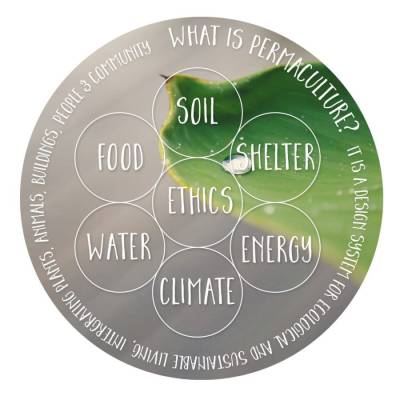
A permaculture is an approach that integrates land, resources, people, and the environment to mimic the natural systems with no waste loops [24]. The following figure sums up the concept of permaculture and other aspects associated with it.
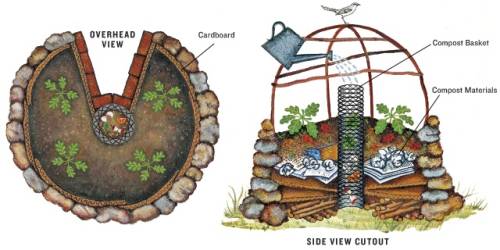
At this point, there are a few solutions that respect the approach of permaculture. One of these is the African keyhole garden, which was designed by CARE in Zimbabwe during the mid-nineties to encourage people to grow their own food. A keyhole garden is a round garden bed with a compost pile in the middle. The garden has a notch in the front, so gardeners can easily add to or turn over the pile. It also has a drainage layer, a soil layer, and a planting area, which combine all the necessities that plants need to grow and thrive [26].
2.4.4 Conclusion
To sum up, the systems involving vermiponics and/or vermicomposting are the most sustainable for food production. Furthermore, it is also clear that imitating natural systems is the most ethical, energy-efficient, and sustainable approach. After plenty of discussion and consideration, the team decided to implement a system that consists of a simple modular 'keyhole garden' structure, with a composting basket in the centre. The team considers this to be an interesting product to smartify, as variables such as temperature, and humidity are important to monitor, and a tracking device could add value to the system.
2.5 Related Solutions
2.5.1 Subpod
Subpod is an in-ground compost system, as seen in Figure 6, that turns food scraps, paper, coconut peat into rich compost. Over time, the worms living in it provide the nutrients from the compost to the garden soil, helping the plants thrive [27].

2.5.2 Biovessel
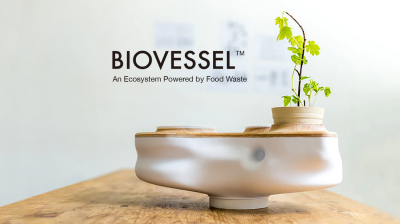
The BioLad and Engineering/Design studio 'BIONICRAFT' is dedicated to biological research, conservation, and innovation. Through biological observation and experiment, they designed the 'BIOVESSEL'. The BIOVESSEL is “an ecosystem powered by food waste”, as their slogan states, that aims to deliver nature to urban homes composting food waste for a sustainable lifestyle [29].
2.5.3 Urbalive
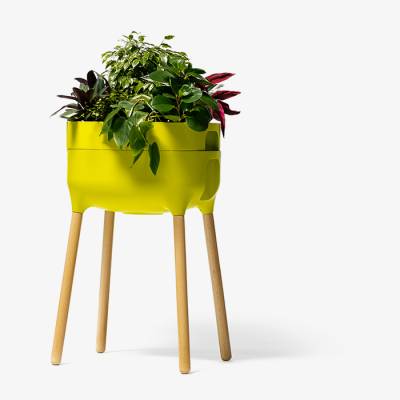
Urbalive provides different options for indoors and outdoors: from simple vermicompostors (“Worm Farm”) to farming systems (“Indoor Planter” and “Outdoor Planter”) [31].
2.5.4 Comparison
| Product | Price (€) | Pros | Cons |
|---|---|---|---|
| Subpod | ~300 | Different sizes Provides everything needed for composting | Price Availability for outside the United Kingdom is conditioned Mainly recommended for outdoors |
| Biovessel | ~200 | Small, portable Great for the inside Appealing design (can be seen as decoration) | Price Little space for plants (fits only one) No information available after 2018 |
| Urbalive | 100-160 | Portable Modular They sell individual trays Cheaper Solutions for both indoors and outdoors Self-watering | The worm tea production and plant production have to be done in separate places/products, and this way it becomes more expensive (~260 €) |
As seen in Table 6, indoor food production is conditioned in the three products analysed. Subpod is perfect for outside (gardens, backyards, etc.), while Biovessel is idealized for the inside, but only for vermicomposting, as it has no space for food production, given the size of the product. Urbalive would be more interesting if everything was combined in one product (plant production and vermicomposting). Therefore, the combination of greater space for plant production with an appealing design is something that has not yet been achieved in the vermicomposting market.
2.6 Summary
Nowadays, endless smart products can be found on the market, with different applications. These objects are divided into five main contexts/markets: smart cities, smart homes, health, mobility, and lifestyle. There are common features for these markets, including remote monitoring, digitalization, and adaptability. Furthermore, people look more and more for products on which they can have a say, on which their opinion matters, and having customers' loyalty and trust is important for companies.
Based on this study of the state of the art, the team decided to adopt the following strategies: manufacture a modular/reconfigurable product with connectivity; develop a product that adds value and that answers to the existing problem of sustainable food production in today's society; choose the most sustainable production strategies and materials possible; be communicative with customers, and open about the manufacturing process and materials used. Therefore, the team will develop a smart modular 'keyhole garden' structure, to fulfil the need for sustainable food production techniques as the world's population grows.
The following chapter is an overview of project management throughout the semester.
3. Project Management
The team followed the agile project management methodology named Scrum, due to its short, iterative cycles (sprints) and flexibility. This is a simple framework to implement and it solves problems such as development cycles, inflexible project plans, and shifting production schedules [33].
3.1 Scope
The scope of the project is important because it gives the team guidelines for making decisions during the project development. It involves determining and documenting what must be done to deliver a product according to its scope, which compiles the functions and features that characterize the product/service [34].
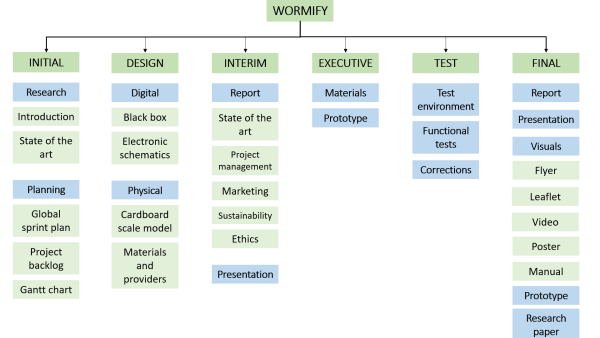
A properly defined scope allows estimating costs and the time required to finish the project. It helps to determine tasks and distribute all resources. After defining the main goal of the project the team improved the planning by a simple hierarchical structure consisting of all tasks and products that are needed to successfully finish the project. By the means of Work Breakdown Structure (WBS), the team divided the scope into six sections: Initial, Design, Interim, Executive, Test, and Final. Multiple tasks belong to each stage, as seen in Figure 9.
3.2 Time
One of the main criteria to succeed in any project is correct time management. For correctly managing their time, the team creates deadlines, sprint plans, and divides tasks while also estimating the time required for each assignment. This ensures continuous workflow and productive sprints. In case some tasks require a longer time than estimated or if they are not performed in time, the whole time management may be affected. This is why it is important to organize the time from the beginning and respect the deadlines assigned to each task.
Using a global sprint plan the team defined the optimal sprint duration and planned the sprints until project end. After that, the project backlog was created including all relevant tasks and deliverables. Based on these the Gantt Chart was developed (Figure 10), using the software GanttProject.

3.2 Cost
In this section, the planned and effective costs of the project are documented. This is important to keep track of the costs and to not go over the budget.
Materials
The cost of the materials for the product can be consulted in the Deliverables section. There, one can find the list of materials for the prototype and also the list of materials for the actual product. In chapter 7, Project Development, we go into more detail regarding the materials and components.
Human Resources
Human resources also play a key role and it is important to include these in the cost. For people to be motivated, rewards are presented, which consist of monthly payments (salary). If the team decides to establish a firm in Porto, where an engineer earns on average 1459 € per month [35] and considering that as a start-up the company would not have profit, the wage of the team members would be lower than the average, as seen in Table 7.
| Employee | Monthly wage (€) | SS - 23.75 % (€) | FCT - 5 % (€) | Insurance (€) | Total (€) |
|---|---|---|---|---|---|
| Ana | 1000 | 1237.5 | 50 | 30 | 1317.5 |
| Elena | 1000 | 1237.5 | 50 | 30 | 1317.5 |
| Fien | 1000 | 1237.5 | 50 | 30 | 1317.5 |
| Jakub | 1000 | 1237.5 | 50 | 30 | 1317.5 |
| Kris | 1000 | 1237.5 | 50 | 30 | 1317.5 |
| Total | 5000 | 6187.5 | 250 | 150 | 6587.5 |
3.3 Quality
Two principles are ensuring good quality: “Right First Time” - the final product should be free from mistakes and “Fit for Purpose”.
Quality assurance is a complex process. It includes management of the quality of products and components, raw materials, assemblies, as well as services related to production, management, and inspection processes.
Wormify specializes in the production of vermiponics system to be as efficient as possible. This is why quality plays a major role in the whole process. These systems are to stay within the standards to provide proper use. Our company meets the following quality aspects:
- Material & Component Quality;
- Product Quality;
- Employee & Team Work Quality;
- Time Quality.
Regarding materials and components, our team wants to use the best materials, taking into consideration sustainability and low impact on the environment. In this case choice of natural materials, minimizing the number of non-renewables is obvious. All the chosen materials are recyclable, mostly aluminium and bamboo. Not only they provide sustainability but also an aesthetic impression.
In terms of product quality, if the requirements are met, it can be said that it satisfies users. As vermiponics provide needs and, in addition, introduce the term of innovation and bring people together, it becomes a desirable product on the market.
To achieve good employee&team work quality, the sense of ownership must be fulfilled. One always takes better care of something that they possess as compared to something that they do not. They feel responsible for the outcome of the product. Reaching a good reputation on the market by the product or service will make the employees feel proud. Through teamwork and participation in product development, a sense of ownership is accomplished.
Time is the key factor in carrying out a project. Having the goal well set and the budget assured, time is the guideline for the project. Thus, if time management is achieved and respected, the project will be carried out in good parameters. Using the Scrum method to organize the tasks for the project we stuck to deadlines.
It seems that quality is a major category that consumers use to evaluate a product or service. Meeting users expectations is crucial for people involved in a business and is driven by the market conditions such as competition.
3.4 People
Human resources are the key factor for a project. Team members contribute to multiple task development. To help organize the work different tasks were allocated to team members. What is more the team knows who is responsible for a certain task. It is visible in the following table.
| Task | Responsible |
|---|---|
| Teambuilding report | Ana |
| Topic choice | Jakub |
| State of art and project backlog | Jakub |
| Blackbox | Ana |
| System schematic and structural drawings + cardboard model | Fien |
| List of materials | Kris |
| Interim report and presentation | Elena |
| List of materials (revised): local providers & price, including VAT & transportation | Fien & Jakub |
| Refined design of the product | Elena & Ana |
| Revised interim report | Kris |
| Start Design | Jakub |
| Finalize design | Elena & Fien |
| Finalize design: high fidelity prototype | Kris & Ana |
| Upload result of functional tests | Ana |
| Upload final report + presentation + video + paper + poster | Jakub |
| Final presentation | Fien |
Not only the team members are involved in the project development. These people together with the team members are called stakeholders. A stakeholder is a person such as an employee, customer, or citizen who is involved with an organization, society, etc., and therefore has responsibilities towards it and an interest in its success [36].
| Stakeholder | Role |
|---|---|
| Team members | Students |
| Benedita Malheiro | EPS coordinator |
| Benedita Malheiro, Cristina Ribeiro, Jorge Justo, Manuel Silva, Paulo Ferreira, Pedro Barbosa Guedes | Supervisors |
| Ana Barata, António Arrais de Castro, Cláudia Facca, Luís Castanheira, Luís Lopes, Paulo Ferreira, Sandra Luna | Teachers |
3.5 Communications
Good communication within the team is essential to obtain a successful project outcome. Because of the pandemic situation and to ensure the good flow of information the following communication methods were introduced:
- Meetings - mainly on Zoom and Microsoft Teams.
- Email - used to communicate with teachers and supervisors.
- Chat - WhatsApp and Messenger groups to access quick, everyday communication between team members.
- Other apps - Microsoft Planner, Microsoft OneNote, Google Drive, Canva.
| What? | Why? | Who? | When? | How? |
|---|---|---|---|---|
| Deliverables | Develop the project | Team members | Before the deadlines | Uploading to Wiki and presenting to the supervisors/teachers |
| Weekly team meeting | To gain feedback | Team members, supervisors | Every Thursday | Microsoft Teams |
| Everyday stand-up | Discuss the work being done on the previous day, set new tasks | Team members | Everyday | Microsoft Teams |
| Sprint planning | Divided into team members, set deadlines and add tasks to the project Backlog | Team members | Every Monday | Microsoft Planner |
| Sprint review | To check the progress | Team members | Every Friday | Microsoft Planner |
| Brainstorming | To find new ideas | Team members | Before taking action | Microsoft Teams, WhatsApp, Messenger, Google Drive |
| Agenda | To pick the topics for meetings with supervisors | Team members | Every Wednesday | Wiki |
| Interim Presentation | To present the current state of the project and obtain feedback from the supervisors | Team members, supervisors | April 22, 2021 | Microsoft Teams |
3.6 Risk
Risk is the possibility of loss or injury. Risk analysis and management is an important project management practice to prevent surprises during project development. The lack of a structured risk management framework leads to:
- Incomplete impact evaluation: no knowledge of the impact on the project goals (scope, time, cost, and quality)
- Lack of transparency and communication gap between team members and outside the team.
Therefore, the implementation of such a framework will provide a conscious and focused risk identification/management, the envisioned project progress with minimal surprises, early and effective communication of project issues, and an effective team-building tool.
The following two tables are related to product and project risks. The risks are evaluated through the following criteria:
- Impact, which can be low, medium, or high;
- Probability, on a scale of 1 (no-very low probability) to 4 (very high probability).
3.6.1 Product Level
| Risk | Cause | Effect | Evaluation | Mitigation |
|---|---|---|---|---|
| Functionality | Problems with suppliers, lack of necessary skills | Incomplete product | Impact: high Probability: 2 | Prototype development and testing, focus on evolving required skills |
| Performance | Wrong mechanisms | Lower sales, unsatisfied customers, bad reviews | Impact: high Probability: 2 | Intensive research and testing |
| Design | Improper design | Lower sales because of the product aesthetics | Impact: high Probability: 3 | Present different designs to different individuals and choose the most liked and efficient one |
3.6.2 Project Level
| Risk | Cause | Effect | Evaluation | Mitigation |
|---|---|---|---|---|
| Team conflicts | Lack of communication | Delays | Impact: high Probability: 2 | Early communication, open discussions, compromising |
| Lack of skills | Lack of expertise in a certain field | Delayed work, inappropriate development of tasks | Impact: high Probability: 2 | Research, turn to supervisors for guidance |
| Time management | Wrong estimations | Delayed work, inconsistent & unfinished sprints | Impact: medium Probability: 3 | Weekly sprint reviews and evaluation |
3.7 Procurement
Procurement is the process of acquiring and buying products, goods and services from external suppliers. This process is essential as the team has to find local suppliers who can provide Wormify with the best possible price and high quality for the needed goods. All parts available in standard formats are bought to save time. In other cases, i.e. the connectors, they are manufactured with the most suitable technique. This gives us money-saving as no margin by the seller is involved and independence of external suppliers.
As sustainability is an important factor, the team must search for suppliers that attach importance to that and try to minimize the number of supplier companies, which is especially important to save costs and transportation pollution.
3.8 Stakeholders Management
The stakeholders' analysis is a structural approach allowing the understanding of a system, by specifying the interests, needs and concerns of the organisms concerned. This tool is especially useful when:
- Resources are limited
- Different stakeholders have opposite interests
- Needs of different parts have to be balanced
- Evaluating another scenario
The method of the stakeholders’ management will be defined in 4 steps:
1. Identify the stakeholders
Firstly list and rate the stakeholders. Then organize it based on 3 levels of involvement: direct (affected directly), secondary (addicted but not directly) and key (actively involved in the project).
2. Value the interest of stakeholders and the potential impact on the project
3. Evaluate the influence and importance of the stakeholders
Rate each stakeholder taking into consideration the following points:
- Power and status (political, social, economic)
- Level of organization
- Control over strategic resources
- Importance in the project success
4. Draft of the strategy of participation of stakeholders
- Weak interest stakeholders with weak role will probably be not very involved in the project and they do not require a particular strategy
- Weak interest stakeholders, but with a powerful role need special efforts to ensure that their expectations are considered and their participation is constructive
- Strong interest stakeholders with a weak role are not who we aim, although they can be opposition, thus, we must keep them informed and acknowledge their viewpoints to avoid disagreement or conflicts
- Strong interest stakeholders and a powerful role should be associated with all project long to ensure their support
The table below shows the comparison of the impact of stakeholders on vermiponics.
| Stakeholder Impact | Strong Influence | Weak Influence |
|---|---|---|
| Strong Power | Team members, EPS Coordinators | Government |
| Weak Power | Vermiponics users, Suppliers | Mass customer, other EPS participants |
3.9 Sprint Outcomes
Scrum is an Agile project management methodology involving a small team led by a Scrum Master, whose main job is to remove all obstacles to getting work done. Work is done in short cycles called sprints, and the team meets daily to discuss current tasks and any roadblocks that need clearing [37]. This framework uses the following:
- Daily stand-up. It is an everyday meeting in which team members discuss the work being done on the previous day, plan the current day, and review the obstacles that have occurred. It is worth mentioning that those meetings should be carried out in a standing position.
- Sprint planning. Every Monday, at the begging of each sprint, the team plans what will be done this week. Then the tasks are allocated to the different team members and their duration is estimated.
- Sprint review. Every Friday, at the end of each sprint, the team reviews the last sprint plan. The tasks are divided into completed and not completed.
- Sprint retrospective. Apart from sprint review, the sprint retrospective takes place every Friday. It is reflected what was positive and what was negative during the last sprint. Based on these three categories are created: start doing, keep doing, and stop doing.
Based on the academic calendar delivered by ISEP, the number and duration of sprints were adjusted. It is shown in Table 14.
| Sprint | Start | Finish |
|---|---|---|
| 1 | 01/03/2021 | 07/03/2021 |
| 2 | 08/03/2021 | 14/03/2021 |
| 3 | 15/03/2021 | 21/04/2021 |
| 4 | 22/03/2021 | 28/03/2021 |
| 5 | 29/03/2021 | 04/04/2021 |
| 6 | 05/04/2021 | 11/04/2021 |
| 7 | 12/04/2021 | 18/04/2021 |
| 8 | 19/04/2021 | 25/04/2021 |
| 9 | 26/04/2021 | 02/05/2021 |
| 10 | 03/05/2021 | 16/05/2021 |
| 11 | 17/05/2021 | 23/05/2021 |
| 12 | 24/05/2021 | 30/05/2021 |
| 13 | 31/05/2021 | 06/06/2021 |
| 14 | 07/06/2021 | 13/06/2021 |
| 15 | 14/06/2021 | 20/06/2021 |
| 16 | 21/06/2021 | 25/06/2021 |
Project Backlog is built including all relevant tasks and deliverables. Project Backlog Items (PBI’s) are prioritized, keeping higher priority items at the top, and lower priority items at the bottom. Each task has a status: To-do, Doing, or Done. It means that the Project Backlog is continuously updated. When the task is done it goes to the bottom of the table.
| PBI | Title | Status |
|---|---|---|
| TR | Teambuilding report | Done |
| TC | Topic choice | Done |
| SA | State of art and project backlog | Done |
| BB | Blackbox | To do |
| SSS | System schematic and structural drawings + cardboard model | Done |
| LM | List of materials | Done |
| IR | Interim report and presentation | Done |
| LLR | List of materials (revised): local providers & price, including VAT & transportation | Done |
| RDP | Refined design of the product | Done |
| RIR | Revised interim report | Done |
| SD | Start Design | Done |
| FD | Finalize design | Done |
| FD | Finalize design: high fidelity prototype | Done |
| FT | Upload result of functional tests | Done |
| FR | Upload final report + presentation + video + paper + poster | Done |
| FP | Final presentation | Done |
Below the completed sprints are presented. As mentioned before they are weekly, based on the Global Sprint Plan and Project Backlog.
| Sprint Plans | ||||
|---|---|---|---|---|
| Sprint 4 (22/03 - 28/03) | ||||
| Task | Estimated duration (h) | Real duration (h) | Members involved | Status |
| Weekly classes | 60 | 60 | Ana, Elena, Fien, Jakub, Kris | Done |
| Finish and upload Blackbox to Wiki | 1 | 1.5 | Kris | Done |
| State of the art | 2 | 3 | Fien | Done |
| Make final product choice | 6 | 4 | Ana, Elena, Fien, Jakub, Kris | Done |
| Sprint 5 (29/03 - 04/04) | ||||
| Task | Estimated duration (h) | Real duration (h) | Members involved | Status |
| Define target group | 3 | - | Elena | Doing |
| Weekly classes | 58 | 58 | Ana, Elena, Fien, Jakub, Kris | Done |
| Research about symbiotic relations | 3 | 2.5 | Jakub | Done |
| Sketches | 3 | 3 | Fien | Done |
| Electronics schematics | 2 | 2 | Ana | Done |
| Finish and upload state of the art to Wiki | 2 | 2 | Kris | Done |
| Sprint 6 (05/04 - 11/04) | ||||
| Task | Estimated duration (h) | Real duration (h) | Members involved | Status |
| Detailed system schematics & structural drawing | 4 | - | Fien | Doing |
| Refine Blackbox | 2 | - | Kris | Doing |
| Weekly classes | 40 | 40 | Ana, Elena, Fien, Jakub, Kris | Done |
| MACOM presentation | 3 | 3 | Ana | Done |
| Energy & Sustainable Development presentation | 2 | 2.5 | Jakub | Done |
| ETHDO: choice for the case study | 1 | 1 | Elena | Done |
| Sprint 7 (12/04 - 18/04) | ||||
| Task | Estimated duration (h) | Real duration (h) | Members involved | Status |
| Upload Interim Report | 50 | - | Ana, Elena, Fien, Jakub, Kris | Done |
| Cardboard scale model | 6 | - | Fien, Ana | Doing |
| Weekly classes | 55 | 55 | Ana, Elena, Fien, Jakub, Kris | Done |
| Sprint 8 (19/04 - 25/04) | ||||
| Task | Estimated duration (h) | Real duration (h) | Members involved | Status |
| Finish cardboard scale model | 5 | - | Fien | Done |
| Prepare interim presentation | 45 | - | Ana, Elena, Fien, Jakub, Kris | Done |
| Detailed System Schematics & Structural Drawing | 30 | - | Fien, Ana | Doing |
| Weekly classes | 20 | 30 | Ana, Elena, Fien, Jakub, Kris | Done |
| Sprint 9 (26/04 - 02/05) | ||||
| Task | Estimated duration (h) | Real duration (h) | Members involved | Status |
| List of materials | 20 | 15 | Ana, Elena | Doing |
| Project development | 50 | 45 | Ana, Elena, Fien, Jakub, Kris | Doing |
| Refine design | 5 | - | Fien | Doing |
| Weekly classes | 50 | 45 | Ana, Elena, Fien, Jakub, Kris | Done |
| Sprint 10 (03/05 - 16/05) | ||||
| Task | Estimated duration (h) | Real duration (h) | Members involved | Status |
| Leaflet (first draft) | 2 | 2 | Elena | Done |
| Start Research Paper | 1 | 1.5 | Ana | Done |
| Power budget | 5 | - | Ana | Doing |
| Sustainability presentation | 15 | 15 | Ana, Elena, Fien, Jakub, Kris | Done |
| 3D video | 5 | - | Elena | Doing |
| Apply teachers' feedback to report | 6 | 5 | Ana, Kris | Done |
| Refined interim report | 20 | 20 | Ana, Elena, Fien, Jakub, Kris | Done |
| Classes | 75 | 75 | Ana, Elena, Fien, Jakub, Kris | Done |
| Sprint 11 (17/05 - 23/05) | ||||
| Task | Estimated duration (h) | Real duration (h) | Members involved | Status |
| Improve 3D video | 1.5 | 2 | Elena | Done |
| Finalize power budget | 1 | 1 | Ana | Done |
| Start building proof-of-concept | 4 | - | Ana, Fien, Kris | Doing |
| ETHDO presentation (case study) | 2 | 2 | Jakub | Done |
| Classes | 50 | 50 | Ana, Elena, Fien, Jakub, Kris | Done |
| Sprint 12 (24/05 - 30/05) | ||||
| Task | Estimated duration (h) | Real duration (h) | Members involved | Status |
| Start user manual | 6 | 6 | Fien, Jakub | Done |
| App mock-up | 10 | 10 | Ana, Kris | Doing |
| Create presentation on the marketing chapter | 4 | - | Kris | Doing |
| Test technical components | 2 | - | Ana | Done |
| Classes | 45 | 45 | Ana, Elena, Fien, Jakub, Kris | Done |
| Sprint 13 (31/05 - 06/06) | ||||
| Task | Estimated duration (h) | Real duration (h) | Members involved | Status |
| Leaflet (final version) | 1 | - | Elena | Done |
| User manual (first draft) | 4 | - | Fien | Done |
| Poster (first draft) | 2 | - | Elena | Done |
| Ethics chapter (final version) | 2 | - | Ana | Done |
| Marketing chapter presentation | 2 | - | Kris | Done |
| Collect materials for prototype | 2 | - | Ana | Done |
| Improve paper | 3 | 3 | Jakub | Done |
| Start final presentation | 1 | - | Fien | Doing |
| Classes | 30 | 30 | Ana, Elena, Fien, Jakub, Kris | Done |
| Sprint 14 (07/06 - 13/06) | ||||
| Task | Estimated duration (h) | Real duration (h) | Members involved | Status |
| Build supporting structure | 20 | - | Ana, Elena, Fien, Kris | Doing |
| Research on materials for the actual product | 3 | 3 | Jakub | Doing |
| Finish the manual (safety guidelines + FAQ) | 2 | - | Fien | Doing |
| Calculations - bending strength of bamboo | 2 | - | Elena | Doing |
| Improve poster | 2 | - | Elena | Done |
| Packaging | 6 | 5 | Ana, Fien | Done |
| App | 5 | - | Kris | Doing |
| Portuguese presentation | 2.5 | - | Ana, Elena, Fien, Jakub, Kris | Done |
| Classes | 35 | 35 | Ana, Elena, Fien, Jakub, Kris | Done |
| Sprint 15 (14/06 - 20/06) | ||||
| Task | Estimated duration (h) | Real duration (h) | Members involved | Status |
| Implement electric circuit on prototype | 4 | 2.5 | Ana | Done |
| Finish code | 8 | 8 | Kris | Done |
| Finish prototype | 16 | 20 | Ana, Elena, Fien, Kris | Done |
| Finish Project Management chapter | 3 | - | Jakub | Done |
| Final Deliverables | 20 | 25 | Ana, Elena, Fien, Jakub, Kris | Done |
| Classes | 40 | 40 | Ana, Elena, Fien, Jakub, Kris | Done |
| Sprint 16 (21/06 - 30/06) | ||||
| Task | Estimated duration (h) | Real duration (h) | Members involved | Status |
| Final presentation | 30 | - | Ana, Elena, Fien, Jakub, Kris | |
3.10 Sprint Evaluations
Using Microsoft Planner and Microsoft OneNote we planned our sprints. It allowed us to review each sprint. Those tasks that were not completed were delayed for the next week until being finished.
The positive sides as for now are final project choice and good teamwork. Thanks to this we can focus on the goal, which is clearly stated. We would love to develop sustainable vermiponics combining it with a water collecting system with a good design using efficient materials. We are looking forward to creating a 3D model prototype based on sketches. In further steps, it is necessary to take into consideration marketing aspects such as branding of our product, ethical ones as well as established budget. Unfortunately, there are also negative sides. One of them is online meetings which result in poor interpersonal contact and difficulties in decision making.
3.11 Summary
Good project management is a pillar that ensures a project development is done with quality, on time and within the budget. It is a very complex process including tracking deadlines, setting a budget, taking control and ensuring that the project has stakeholders support and what is more it lasts from the very beginning to the end of the project.
In the next chapter, 4. Marketing Plan, our team will be introduced in the Marketing term, which is an important strategy to ensure the growth of our business. Current customer will always be our priority. Thanks to the marketing efforts this base can expand. Nowadays social media is a powerful tool to maintain presence and acquire new customers. In brief, marketing provides our business with a better future.
4. Marketing Plan
4.1 Introduction
Creating a marketing plan is critical for any business. Developing a marketing plan will help us think about the purpose, buyer personas, budget, methods, and deliverables for each campaign. We will be able to keep on track with a campaign, notice what works and what does not, and measure the effectiveness of our brand strategy if we have all this information in one place.
The focus of our strategy will be to ensure that Wormify meets client needs and develops long-term and profitable relationships with those clients. To do this, will develop a flexible strategy able to adapt to changes in customer perceptions and demand.
The business environment is a marketing term used to refer to the circumstances and forces that influence a company's capacity to establish and maintain effective customer connections. In this chapter, the first step in achieving this goal is to identify micro and macro factors.
Second, we will conduct an honest and comprehensive SWOT analysis of our marketing strategy document, looking at our strengths, weaknesses, opportunities, and threats. We will perform market research on existing customers to get a more accurate picture of our reputation in the marketplace.
The third step is to identify the strategic objectives by using the SMART methodology. Specific and measurable objectives define the success of a project or initiative. Fourth, we will visualize Wormify concerning the market and competition. Fifth, we will focus on the 4C’s of the marketing mix to decide how to take the new offer to the market and to test our marketing strategy. The final focus will be on the budget and strategy control to ensure that the marketing objectives are attained.
4.2 Market Analysis
A market analysis is an in-depth examination of a market within a particular sector. We will investigate the dynamics of your market, such as volume and value, potential consumer segments, purchasing habits, competition, and other important factors, with this report.
Knowing the market environment will enable us to foresee our current position and establish the potential position of our product on it.
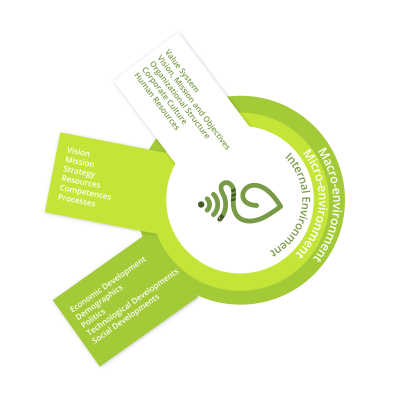
Looking at the environment, a distinction can be made on three levels: macro, meso, and micro.
Macro – contextual level
The contextual level consists of ‘global forces’, such as economic development, demographics, politics, technological developments, and social developments.
Meso – transactional level
The transactional level consists of ‘market forces’, such as suppliers, supply and demand, distribution, competitors, and strategic alliances.
Micro – organizational level
The organizational level includes factors that handle the firm's internal climate. Think about: vision, mission, strategy, resources, processes, products, and services.
Looking at each level's factor will help the Team understand the situation prevailing on the market. Figure 11 presents components of business environments.
Having the information from the market analysis will help us strengthen our market position, minimize investment risk, meet customer needs and demands while staying ahead of the competition. Therefore, we can prepare a valuable product more accurately.
4.2.1 Problem Statement
Vermicomposting is an eco-biotechnology that employs earthworms in the decomposition of organic matter. Given global pro-environmental politics, it could be regarded as an interesting eco-innovation in biowaste management. As a result, it is perfectly suited to the circular economy concept, turning different types of organic waste (domestic and industrial) into renewable energy sources or “biosoils”. It also acts as an alternative to other waste management approaches that are considered unfriendly to the environment. Several different types of organic waste, such as by-products from various industries, have recently been proposed as substrates in the process. Some beneficial properties of vermicompost make it an interesting product for agriculture, gardening, and remediation of polluted areas. Vermicomposting on a large scale is necessary to effectively and globally solve the waste disposal problem.
4.2.2 Internal Analysis
7S Model of McKinsey for internal analysis
To prepare an analysis on our Team – we have decided to take advantage of the 7S McKinsey model as a framework. The model can be applied to many situations and is a valuable tool to improve the performance of your organization or to determine the best way to implement a proposed strategy. The specific layout of the McKinsey model is shown in Figure 12. 7S McKinsey's model examines the factors internal to the organization that can affect its success. It is therefore a useful way of identifying strengths and weaknesses as part of a SWOT analysis.
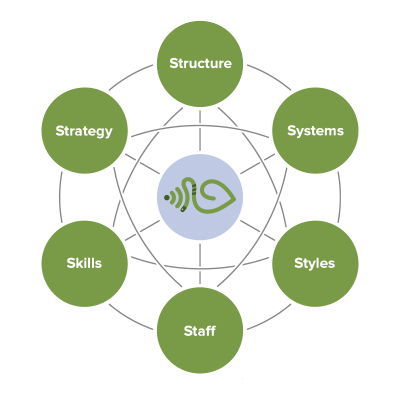
Strategy – the aim of the company and how the organization intends to increase its competitive advantage
Teams generate new knowledge in an organization by combining the explicit and tacit knowledge of individual team members. Team leaders who appreciate implicit knowledge will significantly increase the efficiency of individual interactions and group cohesiveness.
Structure - the division of activities; integration and coordination mechanisms
As team members are active in making decisions, they develop a professional and personal interest in the company and its overall performance. This contribution contributes to improved efficiency as participants are actively involved in different aspects of the project and wish to see their efforts succeed overall. This not only helps with project completion but also simulates a real-world work scenario.
Systems - the main and secondary tasks that are part of the day-to-day operations of the company
Monitoring is critical because it allows the team to ensure that you are meeting your objectives. It also demonstrates that you are performing to the highest level you believe is possible. This assists you in determining ways to improve your results. The project managers are often kept up to date on the team's results.
Skills - the human capital of the organization's skill set and capabilities
The team is composed of members who are dependent on each other, work towards interchangeable achievements, and share their expertise in a specific field. Ana Mendes: Biomedical Engineering; Elena Victoria Tatuc: Industrial Design; Fien Joos: Product Development; Jakub Wyka: Mechanical Engineering and Applied Computer Science; Kris Petrevski: Information and Communication Sciences for Business and Management.
Each of us is comfortable with using most project development and research tools towards project completion.
Staff - the team’s core competencies and distinctive capabilities
Identifying and organizing work around each team member's specific strengths and skills ensures enhanced team member performance and commitment, as well as increased efficiency, which contributes to a successful project. It's no wonder, then, that cultivating a strengths-based organizational culture is regarded as critical to the future of work.
Style - key groups' typical behaviour patterns, such as managers and other professionals
Teamwork is organized by using the Scrum method. In Scrum, the development team is self-led, and every member works together to complete each sprint. The members of the development team agree on how to better complete the deliverables.
Shared Values - what engenders trust and link the team together
We collaborate to achieve shared goals by developing relationships based on mutual respect, constructive communication, and trust. We achieve our goals by self-motivation, resourcefulness, and the ability to change as we go. We go above and beyond to add value to the project and our customers. To achieve our goals, we use both our individual and collective abilities.
4.2.3 External Analysis
The environmental determinants research takes into account three aspects of the environment: the macro-environment, and meso-environment. Furthermore, we will use PESTLE to provide a deeper understanding of the industry, alertness to risks, and a method to exploit opportunities. We'll go through each in greater detail.
4.2.3.1 PESTEL Analysis
PESTEL analysis is a strategy for reducing business risks. We can obtain useful advantages by investigating the Political, Economical, Social, Technological, Legal, and Environmental factors. These benefits aid in the concept process, product creation, product launch, content marketing strategies, and other factors that contribute to success. PESTEL analysis will assist the Team in considering a wide range of influential factors that may influence the success or failure of our product.
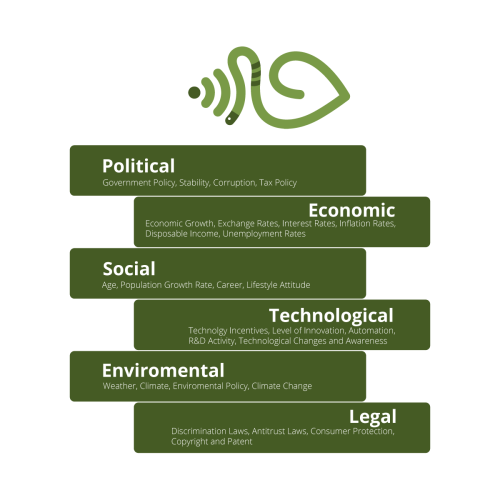
- Political
The product does not have any political impact, thus this category is not relevant for our project.
- Economic
Vermicompost production is also an ‘economically productive’ process as it ‘reduces wastes’ and consequently saves landfill space. Construction of engineered landfills incurs 20 to 25 million US dollars upfront before the first load of waste is dumped. Over the past five years, the cost of landfill disposal of waste has increased from 29USD to 65USD per ton of waste in Australia. [38]
Earthworms turn a ‘negative' economic and environmental value commodity, ‘waste,' into a ‘highly positive' economic and environmental value product, ‘highly nutritive organic fertilizer' (brown gold), which improves soil fertility and farm productivity to generate ‘safe food' (green gold) in farms. Vermiculture has the potential to preserve the global ‘human sustainability cycle,' which entails processing food in farms from food and farm waste.
- Social
Life Cycle Assessment (LCA) demonstrated that vermicomposting performed satisfactorily in terms of global warming and eutrophication potential while dumping the vermicompost produced could lead to increased eutrophication. However, this is still much lower than the eutrophication caused by untreated manure dumped openly.
- Technological
The product is based on advanced vermiculture technology that transforms organic waste into value-added environmentally friendly goods that can increase soil fertility and productivity on a large scale.
- Legal
Over 4500 unregulated composting/vermicomposting operations are estimated to be present, posing a risk to soils and groundwater. The vast majority of these small-scale operations (approximately 95%) are vermicompost producers on a small scale. There are only 15 managed and legally permitted vermicomposting plants, and the number of plants producing legally authorized vermicompost is currently limited to 15. This number needs to increase for Turkey to become a leading producer of vermicompost by 2023 [39].
- Environmental
Earthworms are natural recyclers. They play an important role in breaking down organic matter and fertilizing the soil simply by feeding and pooping regularly (about 1.5 times their body weight a day). The worm cast that comes from the other end is rich in nutrients and bacteria that are beneficial to plants. Scientists discovered that worm casts contain up to five times the amount of key nutrients found in the surrounding soil.
Competitive Matrix
A competitive matrix is a technique for industry analysis that analyses the attributes of different brands in your market sector to determine their differences, strengths, and weaknesses. This data assists you in identifying your unique competitive edge and prospects for business growth.
We will use a competitive matrix in a form of a chart that lists each competitor along with a list of their features and benefits. Table 17 shows the differences between the Wormify composting system and other similar products.
| Urbalive Strengths (+) Weaknesses (-) | Subpod Strengths (+) Weaknesses (-) | VermiGo Strengths (+) Weaknesses (-) | Biovessel Strengths (+) Weaknesses (-) | Wormify Strengths (+) Weaknesses (-) | |
|---|---|---|---|---|---|
| Target Markets | Indoor kit made to compost kitchen bio waste – usually used in households, classrooms, offices (+) | Designed for high and low-volume food waste producers across the globe (+) | Designed for vertical gardening to eliminate home food waste (+) | Meant for beginners that like minimal design and ease of usage (+) | In-garden composting system meant for individual or community use (+) |
| Product | - Self watering feature (+) - Suitable for home application (+) - Red Dot design award (+) - Least functionalities (-) - No in-built sensors (-) | - No smell, no pests (+) - Quick assembly process (+) - Both outdoor and indoor usage (+) - Stable temperature - 9KG composting capacity per week (+) - Compact design (+) | - Activated carbon filter (+) - Collector for vermicompost and nutrient tea (+) - Wall mountable (+) - 3KG processing capacity per (-) - Modular and extendable (+) | - Easy to use (+) - Moisture Sensor (+) - pH Level Sensor (+) - Sprayer (+) - Designed for indoor usage (+) - Odorless (+) | - Compact and modern design (+) - Moisture sensor (+) - Temperature Sensor (+) - pH Level Sensor (+) - Connectivity with phone app (+) - Odorless (+) - 6KG composting capacity per week (+) - Modular and extendable (+) |
| Price | Lowest retail price (-) | Higher retail price (-) | Unknown retail price (?) | High retail price (-) | Unknown retail price (?) |
| Place | Online shop: less advertising, using online retailers | Kickstarter and Indiegogo at the beginning then transitioned to online shop. Dedicated to social media marketing, creating brand awareness and publicity. | Does not sell at the moment – it is in a stage of launching | Same as Subpod | Same as Subpod |
| Promotion | - Active on Instagram but limited to Polish market (-) - Facebook not active (-) | - Facebook and Instagram activity creating brand awareness (+) - Modern website (+) | - Not active on Facebook or Instagram (-) - Website is outdated (-) | - Active on Facebook (+) but not on Instagram (-) - Website is too cluttered (-) | - Modern website is in process of making (+) - Social networks; to target modern farmers (+) |
| (Potential) Competitive Barriers | Inferior product (-) | Superior product (+); not many smart functionalities (-) | Currently a concept and not a physical product yet (-) | Complete product (+); Lots of functionalities (+) | Medium product (-); Community must use it to see its effects (-); Creation of garden community (+) |
4.3 SWOT Analysis
Using a SWOT analysis as a strategic tool brings the whole team together, facilitates involvement in the implementation of the company strategy, and promotes shared awareness of key issues affecting your performance. Creating a SWOT Matrix does not necessitate advanced training and is relatively inexpensive, save for the time of those involved. The acronym SWOT stands for Strengths, Weaknesses, Opportunities, and Threats, and we will use SWOT analysis to evaluate these four facets of the market.
SWOT analysis is presented in Figure 14 for Team Analysis and Figure 15 for product analysis.
4.3.1 Team SWOT Analysis
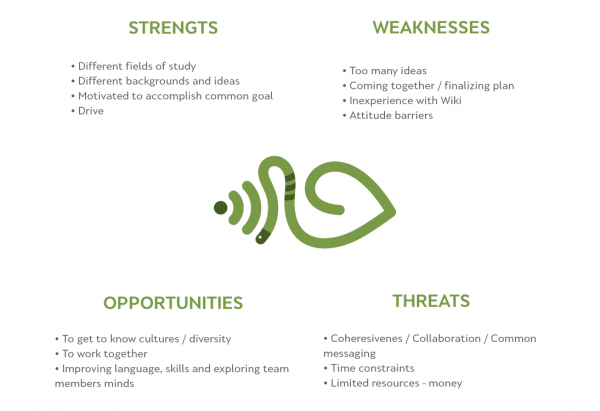
4.3.2 Product SWOT Analysis

Practical recognition of the SWOT analysis's weaknesses and threats is the first step toward countering them with a comprehensive and innovative collection of strengths and opportunities.
4.4 Strategic Objectives
Strategic goals are statements that suggest what is crucial or essential in your organizational strategy. In other words, they are targets that allow the team to understand their strategic goals and to decide if their plan is successful and well implemented. As a result, we have agreed to use the SMART approach to set targets.
SMART is an acronym that stands for Specific, Measurable, Achievable, Realistic, and Timely. Therefore, a SMART goal incorporates all of these criteria to help focus our efforts and increase the chances of achieving the end goal.
| Letter | Factor |
|---|---|
| S | simple, sensible, significant |
| M | meaning, motivating, memorable |
| A | agreed, attainable |
| R | reasonable, realistic and resourced, results-based |
| T | time-based, time limited, time/cost limited, timely, time-sensitive |
General mission and vision strategic objectives:
Economical strategic objectives:
- To contribute to global ecological economic recovery, a profitable and sustainable method of producing high-quality organic goods, as well as a stable and optimistic agricultural outcome, is to be achieved.
- We want to have a stake in this market by pursuing a strong role in Portugal. We aim to contribute to the national economy by rising the export rate further with each passing day.
Customer/Learning strategic objectives
- Our goal is to educate the public, individuals, companies, and organizations about the benefits of compost and to recycle organic materials from landfills to generate soil for community-based agriculture projects.
- We want to ensure the production of nutritious food healthily to help future generations survive in a healthier world.
- We imagine a world in which government, corporations, families, and individuals work together to sow the seeds of the community so that we can shift our perception of our “waste” stream.
Environmental Strategic objectives
- We envision a world in which everyone disposes of food waste and compostable materials in an environmentally responsible manner, and landfills are never an option.
- We imagine a world in which “waste” is regenerated into living soil, curing the Earth and nourishing our gardens, bodies, and souls.
Transforming Soil. Transforming Lives. Transforming Our Communities.
4.5 Segmentation
To divide properly a broad market into small segments comprising of individuals who have similar needs, requirements, and interests the process called Market Segmentation has to be done. Three main categories are taken into considerations:
- Geographic segmentation
- Demographic segmentation
- Psychographic segmentation
4.5.1 Geographic segmentation
The target market for vermiculture is Southeastern Europe, more precisely – countries that are self-sufficient in terms of agricultural food. According to all economic estimates, the application of vermicompost to grains, fruits, and greenhouse vegetables is more profitable than traditional compost in Turkey conditions [40]. Farmers should consider, however, that the advantages of vermicompost are not only plant-nutritional but that the disease resistance attributed to vermicompost decreases the cost of chemical pesticides as well.
4.5.2 Demographic segmentation
The main factors affecting this part are:
- Income – the citizens whose average monthly salaries are at least at the satisfactory level and actually who live in countries that are favourable for farming.
- Occupation – we assume that the clients whose professions in everyday life are connected with agriculture and farming are more likely to buy a vermiculture system due to their specific job than other consumers.
- Education – greater acceptance of vermicompost by farmers may come with more education and an understanding that sustainable farming also protects the environment.
Variables such as age, gender, religion, or race are not included in the demographic segmentation process since they do not influence the demand for our product.
4.5.3 Psychographic segmentation
Clients may be divided into different groups based on:
- Social class – consumers from the middle and higher class are assumed to be much more interested in the potential purchase of Wormify.
- Lifestyle and personality – clients whose jobs and lifestyles are already deeply connected with agriculture, as well as an awareness that implementing such a system will provide employment opportunities by protecting the environment, augmenting crop production when used as a fertilizer supplement, and assisting in the maintenance of ecological balance.
4.6 Strategy/Positioning
Earthworm and vermicompost markets are expanding, representing a worldwide growth in interest in vermiculture and vermicomposting. Based on our marketing research, we have chosen to concentrate on companies, organizations, and governments all over the world (Business to Business - B2B), with a secondary focus on individuals who want to divert their household waste from the waste stream and recycle it into worm castings on-site (Business to Customer - B2C).
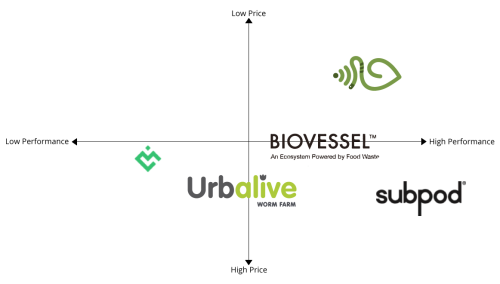
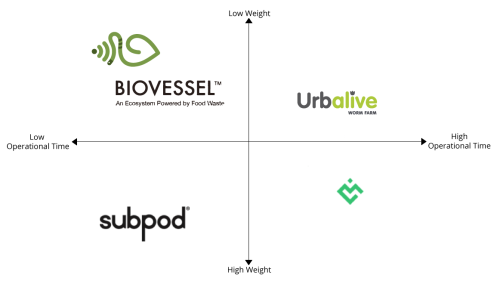
The team has decided to break into the bio marketplace with a unique and cost-effective product named Wormify. Knowing the benefits that Wormify brings to the table, we will further analyse it as a product. An effective positioning strategy considers the strengths and weaknesses of the team, the needs of the customers and market, and the position of competitors. The purpose of a positioning strategy is that it allows the team to spotlight specific areas where they can outshine and beat their competition.
During the project semester, we collected different proposals to find a suitable name for our vermiculture project. Towards the beginning of the project, a survey was created in which the possible brand names were divided into the two groups “closed-loop” and “sustainable/local” to find out which brand name and which group was preferred.
In the end, we received three possible brand names with the following order:
- Wormify
- Rootry
- SMOV (smart, modular vermiponics)
The team has decided to go with Wormify. We also researched the WIPO (World Intellectual Property Organization) to verify that the brand name is not already registered. This ensured us that we can use Wormify as a name for our project.

As for the logo - the goal was to design a logo that’s mostly related to organic foods. That’s why we decided to go with green as the predominant colour in our logo. The following figure has the three elements that make up the logo, and which relate directly to the product - Wi-Fi, worm, and leaf.

4.7 Adapted Marketing-Mix
Using a marketing mix is an ideal way to help ensure that ‘putting the right commodity in the right spot,…' occurs. A marketing mix is an important tool for determining what a product or service may deliver and how to prepare for a successful product offering. The marketing mix is most widely implemented using the four Ps of marketing: price, product, promotion, and place. These four groups, however, correspond to four other, more practical marketing pillars: the 4 C's.
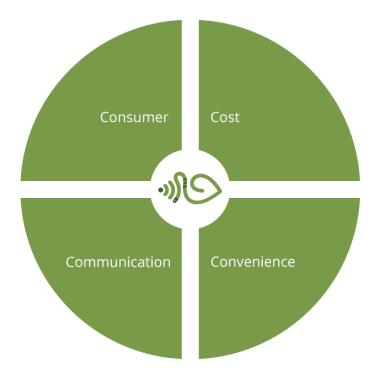
The first C in this marketing mix is the customer’s wants and needs. Wormify was created to make mixing and aerating compost as simple as possible. Customers can properly mix and aerate their compost with just a few minutes of light labour each week, creating the ideal conditions for quick decomposition of your organic waste.
The second C in this marketing mix is cost. Price is just a small part of the total cost of purchasing a commodity from a consumer. It is important to assess the total cost – not just the price – of the commodity to the consumer. Wormify system will be available in three variations: the basic plastic box with components, the box with a supporting bamboo construction and the complete garden construction for large space. Prices will range from 120EUR for the basic plastic box to 240EUR for the full construction with shipping included. Customers can also request a quote to receive a price estimate for the complete garden construction.
The Third C within this marketing mix is convenience. In the 4Ps marketing strategy, convenience is equivalent to “location.” These two, however, are opposed. The term “place” simply refers to where the product will be sold.
The total weight of the Wormify in the shipping box will be approximately 11.3 kilograms/24.9 pounds. Because of the weight constraint we've decided to subsidise shipping to make it as affordable a possible; therefore we plan primarily to ship to European countries in the launch phase to ship worldwide soon.
The fourth and final C in this marketing mix is communication. Communication is often important in business marketing; without it, the four Cs will be ineffective.
The essence of our job is to create Wormify as a brand that people can resonate with and enjoy. We do so by developing the platform’s marketing campaigns and managing our social media channels, acting as the bridge between our internal stakeholders and our users. Not only do we want to effectively introduce our product to as many people as possible, but we also want users to find value in our offerings and continue “sticking” with Wormify.
The four C's of marketing can be extremely useful in any marketing campaign. This strategy requires marketers to thoroughly understand their target audience before developing a product. This approach necessitates coordination from start to finish and starts with knowing what the consumer wants and needs from your product.
4.8 Budget
The objectives for the media recommendations are to increase consumer exposure, increase traffic awareness, and create product awareness within Wormify’s target market. To achieve these objectives, online and printed magazine advertisements, sponsorships at agriculture trade shows and online advertisements will be utilized. A common theme will be created across all platforms to tie all aspects of the advertising campaign together to create a cohesive message to promote the message of Wormify: Feed the Soil, Feed the World
Execution of Advertising Objectives
Wormify wants to market its goods as natural, organic, and useful, thus our ads should reflect that. Print ads and direct sales tactics will account for the great bulk of financial concerns. Wormify, with appropriate implementation, will be able to place advertising in both print and online periodicals that have previously lauded Wormify's advantages over the competition. Print distribution allows for a larger audience, but internet advertising provides for real-time exposure to the customer as soon as they access a website. The timing of these approaches will be based on pulse advertising since all marketing methods are designed to be implemented during peak periods of lifestyle changes. This campaign will emphasize consistency and regularity of promotion to ensure that customers remember the benefits of vermicomposting and Wormify.
Media Recommendations
The media suggestions' goals are to enhance consumer exposure, traffic awareness, and product awareness within Wormify's target market. To accomplish these goals, online and printed magazine ads, sponsorships at agricultural trade events and internet ads will be used. A common theme will be created across all platforms to tie all aspects of the advertising campaign together to create a cohesive message to promote the message of Wormify: “Feed the Soil, Feed the World”
Social Media Presence
Wormify will leverage social media platforms to raise brand recognition among frequent internet users. The plan is to feature an interactive video advertisement on Facebook that showcases the product and its features while educating the customer about the importance of vermicomposting. Through this, Wormify will gain the interest and attention of potential customers. This social media platform also utilizes cookies to track user information, thus when a user clicks on a Wormify advertisement, it will register as an interest of that user, causing the advertisement to pop up more frequently. These advertisements will be featured during January, March, May, September, November, and December, costing a total of $1,500. The frequency of these advertisements will ideally trigger a consumer purchase response during Fall and Winter holiday seasons.
Combined Media Recommendations
Wormify anticipates that a larger market base will enhance total website traffic. Users will be obliged, either knowingly or unwittingly, to visit Wormify's website by embedding links to it in every online advertisement. When they arrive at the site, they will see the Wormify smart composter. This is a straightforward way to increase website traffic at a low expense.
Additionally, print advertisements as well as direct marketing techniques will feature business cards with the company logo, product name, and website URL to encourage prospective consumers to look at the website for additional product information and purchases. This is a call to action of sorts, as the consumer will need to visit the website to get the full technological perspective of how Wormify smart composter can make a lasting, positive impact on their life.
Increased website traffic indicates that customers are actively recalling Wormify smart composter. If the consumer recalls the brand, they are more likely to develop an affinity for those products and purchase them, increasing Wormify's market share. These media ideas are likely to educate, involve, and engage customers in Wormify's campaign for the upcoming fiscal year.
The Wormify smart composter marketing budget allocation is forecasted in Table 19.

4.9 Strategy Control
Strategic control is a method of managing the implementation of your strategic strategy. It is unusual as a management process in that it is designed to deal with unknowns and ambiguity while tracking the execution and subsequent results of a plan. It is largely concerned with identifying and assisting you in adapting to internal or external elements affecting your strategy, whether or not they were initially included in your strategic planning.
The strategy control process is primarily defined by six phases:
- What to control
Our mission is to grow a global community of everyday people committed to changing the way they think about waste. It's a huge issue and sometimes doing the right thing can feel so confusing, no matter how aware we are. But one simple habit can create a big change. When food waste ends up in landfills nothing good happens. Greenhouse gasses, soil, and water contamination, it's a real mess.
The good news is that when we compost food waste it creates fertile soil that grows healthy food. It's a simple and practical way to do our bit and participate in the emerging Circular Economy that views all waste as a resource.
- Set standards
The Wormify has a unique modular design, which allows multiple systems to be installed in one bed and cater to larger volumes of waste.
It allows the customer to compost directly in your garden allowing the worms and microbes to distribute nutrients into the soil.
Because composting is performed in the soil, the system is insulated, meaning that the customer can compost in a variety of climates.
- Measure performance
Wormify creates a safe environment for compost worms and aerobic (odourless) microbes to convert organic household waste into vermicompost. The worms move through the perforations in the underground part, aerating and carrying those nutrients into the surrounding soil, creating an optimally fertile environment for plants to thrive. - Compare performance
Conventional household compost systems, such as tumblers, worm towers, and those ubiquitous big black buckets, sit above the ground where the material, worms and microbes are exposed to extreme temperatures.
When compost gets too hot, and not correctly managed, it becomes anaerobic and turns into a foul-smelling, greenhouse-gas-emitting sludge that attracts vermin and makes composting a drag – as well as a complete waste of time. Managing these systems is labour-intensive and difficult. Wormify eliminates these issues and is practically maintenance-free.
- Analyse deviations
A typical mistake in worm feeding is assuming that they can or would consume anything organic or biodegradable. In reality, there are some popular foods and organic materials that should not be composted in a vermicomposting system:
- Grass clippings are a fantastic addition to a conventional compost pile, and worms will consume them in their natural environment, but they will heat the soil and kill all of the worms in a vermicomposting system.
- Meats, oils, and dairy products can be treated in a closed compost system, but not in a vermicomposting system.
- Citrus can decrease the pH of the vermiculture environment. Citrus peels or leftovers should make up no more than 20% of any given meal.
- Excessive salt in leftovers should be avoided as well because salt might kill worms. - Decide if corrective action is needed
Wormify began with a simple idea: make composting a part of everyday life. We believe that if we can do that, we can teach people to love the soil their food comes from, and make the world a little bit better together. To achieve this purpose and avoid risks we have created a comprehensive FAQ and User Manual.
Whenever there is a bottleneck in the business – we need to first identify the cause and then run a Plan-Do-Check-Act (PDCA) cycle to improve the specific area that is causing problems. PDCA cycle is an iterative process for continually improving products, people, and services. It became an integral part of what is known today as Lean management. The Plan-Do-Check-Act model, represented in Figure 21, includes solutions testing, analysing results, and improving the process.
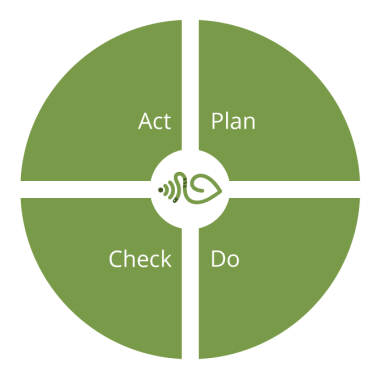
- Plan: Recognize an opportunity and plan a change.
- Do: Test the update. Carry out a small-scale analysis.
- Check: Examine the exam, evaluate the outcomes, and identify what you've learned.
- Act: Take action based on what you learned in the study phase.
4.10 Summary
Based on this market analysis, the team decided to create Wormify- a modular, in-garden composting system meant for individual or community use. It uses the movement of worms and microbes across the garden bed to disintegrate waste and enrich the soil, which then becomes ideal for growing nutrient-dense food.
Wormify is for waste warriors who want to reduce waste, enhance soil, and grow food without generating vermin, odours, or making a mess. Wormify accomplishes this by using naturally occurring worms and microbes in the surrounding soil. Wormify is an effective and low-maintenance solution for any organic waste, including lawn and garden waste, paper, and even clothes.
Using Wormify is much easier than any other form of composting. The Wormify is embedded in the vegetable garden and has top vents that rise above the ground. The machine is stocked with live worms, castings, and starter content. After six days, food and other waste may be thrown into the box, which has an aerator method for mixing. After that, the box is left for 10 days to allow composting to occur. The finished, rich compost soil is then removed and used in the garden.
The underlying message of Wormify is, ‘Feed the soil, feed the world’.
The following chapter focuses on the company's long-term sustainability. This allowed the team to see which eco-efficiency initiatives can be implemented to make the business and product more sustainable.
5. Eco-efficiency Measures for Sustainability
5.1 Introduction
Sustainability is a strong concept how has the value to keep us healthy as a society. The “Brundtland Commission” (this commission must connect countries to pursue sustainable development together) released its final report, Our Common Future, which defines sustainable development as “a development that meets the needs of the present without compromising the ability of future generations to meet their needs.” [41].
These days, most organizations are seeking to attain sustainable development through assessing green performance and the main criterion is Eco-efficiency. Eco-efficiency is an improved measure of sustainability because it connects environmental impacts directly with economic performance and it works as a valuable tool to approach sustainable development [42].
The integration of vermiponics technology in vertical farming can be a suitable and sustainable alternative for futuristic urban farming methods. According to Maurya et al [43], vermiponics is a more environmentally friendly technique than hydroponics since the vermiwash comprises large amounts of plant nutrients, amino acids, and humic acids for plant growth.
For over 20 years, the applicability of the concept of sustainable development has generated a major impact on the daily lives of humans and entire planets. The road to the success of any product is made by choosing the most sustainable strategies. The product follows the sustainability process which is made up of three dimensions illustrated in Figure 22: environmental, economic, and social; pawns that need to be considered together to meet the needs of the present without compromising the ability of future generations. The team aims to implement sustainability as a guiding tool for the entire project.
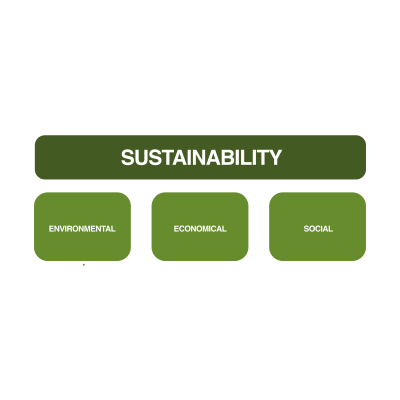
5.2 Environmental
The importance of environmental sustainability is to improve the quality of human life while living within the carrying capacity of the earth's supporting ecosystems [44]. Therefore, this affirmation leads to the main question about how humans should change the way they live to secure a sustainable life for themselves and future generations.
Wormify intends to solve the enormous food waste problem by composting it in a worm environment and providing the resulting fertilizer to help nourish plants. Therefore, the system has the potential to improve the urbanized food production and decrease food waste.
One fact about the food waste problem is that 33 % of all food produced is lost or wasted, making up more than 50 % of global landfill waste. The results of the study suggest that roughly one-third of food produced for human consumption is lost or wasted globally, which amounts to about 1.3 billion tons per year. Producing food that will not be consumed leads to unnecessary CO2 emissions in addition to the loss of economic value of the food produced [45].
Wormify will be mainly made out of two materials - bamboo and aluminium. Bamboo is a durable material with high modulus elasticity and tensile strength which are needed in this product. Aluminium is one of the most durable metals and it is known as the “green metal” due to its infinite lifespan. Due to its recyclability, the team aims to purchase recycled aluminium to further reduce the impact of our product. The packaging is also a strong feature for Wormify, as it will be as compact as possible and made of recycled corrugated cardboard that can be immediately used in Wormify itself as it is compostable. Regarding energy, the team reduced the components to a minimum and chose a controller with a low-cost and low-power system. To further reduce energy consumption, a solar panel will be implemented to power the system.
Therefore, Wormify will provide food to the growing global population while also avoiding food waste from ending up in landfills. The team will make the best effort to improve their eco-efficiency measures along the way.
5.3 Economical
According to the University of Mary Washington's Office of Sustainability [46], economic sustainability refers to practices that support long-term economic growth without negatively impacting social, environmental, and cultural aspects of the community. To be sustainable, a business must be profitable. The correct management of a project from an early stage will reduce errors or negative impacts that may occur regarding costs.
Following the previous section, eco-efficiency measures reduce the environmental impact of the company, as well as costs, given that sustainability strives to reduce materials/energy/emissions and to make a product last. Wormify is made of materials that stand the test of time - aluminium and bamboo. The bars of the supporting structure has two different dimensions, the longer ones will be as long as a standard size and these will be twice or thrice the size of the smaller ones, this way minimizing material loss. All the connectors have the same shape and size, which makes it easy to produce them and reduces the costs.
Wormify has the innovative potential to combine sustainable practices, technology, and money-saving measures.
5.4 Social
This pillar is “a process for creating sustainable successful places that promote well-being, by understanding what people need from the places they live and work. Social sustainability combines the design of the physical realm with the design of the social world – infrastructure to support social and cultural life, social amenities, systems for citizen engagement, and space for people and places to evolve.” [47].
One of the abilities that this project has is to bring people together through the rooftop community garden. The neighbours can create an environment that is focused on health, wellness, and education for all of those who are interested in the quality of life and social respect. This urban farming has benefits such as reducing carbon emissions, increasing local economic growth, increasing public health and improving food security.
Many studies have explored that the “community gardens can improve gardeners general health, lower their obesity rates or depression, and improve mood or satisfaction with life. These health benefits may derive from the restorative capacity of nature, aesthetic experiences, improved social relationships, emotional connections, political engagement, provision of a sense of freedom, encouragement of physical activity, or reshaping the nutritional environment” [48].
5.5 Life Cycle Analysis
Life cycle analysis is a technique for assessing the environmental aspects associated with a product over its life cycle. The most important criteria are:
- Analysis of the contribution of the life cycle stages to the overall environmental load, usually to prioritize improvements on products or processes;
- Comparison between products for internal use [49].
To describe the process we need to get through the different stages of a product’s life, such as raw material extraction through materials processing, manufacture, distribution, and use. In this ecodesign wheel, the final stage is recycling, here we need to optimize the end-of-life systems to approach infinity recycling.
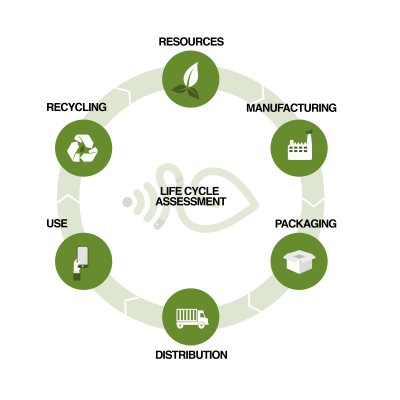
Resources
To reach an optimal level of recycling for our design, we need to use organic, recyclable, renewable, non-toxic, and reusable materials.
Another solution would be to work with other shops in the area to see if they can use the excess materials and see if they have any we could leverage in exchange. At the same time, we will verify their sustainable value.
Regarding the electronic components, the team will reduce the emissions of these as much as one can, starting by using a solar panel to provide energy as well as trying to choose the most sustainable components.
Green materials come in many forms. They can range from degradable circuit boards and organic electronics to metals that are infinitely recyclable and reusable. Organic and inorganic materials can both be considered “green”, depending on the type of material and how it is implemented. On the inorganic side, aluminium is considered a 'green metal' due to its recyclability and incredibly long lifespan. Aluminium is known as the 'green metal' and 'the best eco metal' due to the fact it has a virtually infinite lifespan. It can be recycled repeatedly without losing quality [50].
Besides not being as bad for the planet, greener materials often accomplish the same performance as their cheaper, non-green alternatives. If quality is equal or even higher, the smart way is to market the greener materials used in the product. Consumers are becoming more responsive about how their investment affects the environment and manifest the environmental benefits of sustainable materials will often result in higher sales.
Manufacturing
The overall goal of this stage is to minimize negative environmental impacts. One solution would be to increase energy efficiency, for instance, minimizing energy use in production or use renewable energy consumption; some options can include sunlight, wind, rain, and waves.
The performance of optimized production methods and operations continuously can be improved by reducing the production steps. As well, producing less pollution and emissions will help the Earth and also retain the working environment cleaner and safer. In a company, sustainable manufacturing not only generates more sustainable products but will also increase social and environmental benefits.
Packaging
Our packaging for the product will reach an optimal level of sustainability by using less material. As well, the packaging will be designed to reuse it in the same or similar application, it will be recyclable, but most importantly it will be compostable.
The Sustainable Packaging Coalition offers the following 8 criteria for packaging to be considered sustainable: [51]
- Is beneficial, safe & healthy for individuals and communities throughout its life-cycle;
- Meets market criteria for performance and cost;
- Is sourced, manufactured, transported, and recycled using renewable energy;
- Optimizes the use of renewable or recycled source materials.
- Is manufactured using clean production technologies and best practices;
- Is made from materials healthy throughout the life cycle;
- Is physically designed to optimize materials and energy;
- Is effectively recovered and utilized in biological and/or industrial closed-loop cycles.
Multiple studies have indicated that consumers are interested in sustainability factors when choosing which brands to do business with. Being more sustainable can help acquire more customers and raise loyalty. Therefore, the choice for the packaging material is cardboard because of its compostability, as it can be immediately used on Wormify, but it also can have other destinations as previously mentioned.
Distribution
A clarification is that our product will be delivered at first in the place of origin. One of the key things that our distribution industry can do is to promote a more sustainable way. While many companies continue to rely on trucks that emit harmful fumes, our distribution company has switched to clean idle trucks. These vehicles allow drivers to idle their engines without having to worry about dirtying the environment in the process [52].
Another strategy would be CO2 footprint reduction through detailed analysis of logistics and transport emissions, integrating operational performance, calculating the footprint of the building stock and machines, and making recommendations for reduction levers. Further, including more environmentally friendly logistics packaging solutions, as well as reusable, with economic and environmental business cases and assistance in setting up [53].
Use
The design is smartly conceived to have as long and resisting life as possible. Because the product is completely designed for disassembly, all parts can easily be replaced. This extends the life cycle of the product as well as the recyclability.
Most of all, the product also includes a rainwater system that is collecting the run-off from a structure or other surface to store it for later use.
Recycling
One of the main strategies regarding the end of our product life is the concept of reverse logistics, transforming by-products or waste materials into new materials or products of better quality or for superior environmental value.
This reverse logistics business model benefits both the consumer and the environment as it considers the whole lifecycle of the product, helps to improve product reliability, and avoids the need for consumers to replace broken consoles unnecessarily through an efficient collection, repair, and return process [54].
Including eco-labelling and guidance on how to recycle and dispose of, also using prepaid return shipping labels will minimize negative environmental impacts.
5.6 Summary
The study case of eco-efficiency measures for sustainability offered the group a deeper understanding of how the product can change positively the lives of people living in multiple communities.
Based on environmental assessment, our vermiponic garden system will be a long-lasting design to embrace quality and answers to existing issues of sustainable food production. At the same time, the earthworms are living in a healthier environment. After the vermicomposting process, the compost created by the worms, which contains valuable nutrients, is beneficial for corp plants. Fertile soil that has a rich supply of compost will feed the garden soil and help the plants grow.
The following table presents the WBCD main aspects of eco-efficiency and their application to Wormify.
| Principle | Measure |
|---|---|
| Reduction of energy, water and virgin material use | The team will use recycled aluminium and cardboard, as well as a solar panel to reduce energy |
| Reduction of waste and pollution levels | The size and shape of the components prevents waste and pollution |
| Extension of function and therefore product/service life | The modularity of our product allows for an extended lifespan because each component can be easily replaced |
| Incorporation of life cycle principles | The team implements measures regarding all life cycle stages, especially end-of-life |
| Consideration of the usefulness and recyclability of products/services at the end of their useful life | Our clients will have the option to return each product (or just a component) to the factory. We will recycle used products and reused parts |
| Increased service intensity | Invest in client service, with repair points, home visits; Manual with clear instructions and FAQ |
Moreover, our product integrates itself into the path towards four important United Nations Sustainable Goals [55]:
- Goal 2 - End hunger, achieve food security and improved nutrition and promote sustainable agriculture: Wormify will help solve the problem of feeding the increasing global population with a sustainable approach regarding organic food production.
- Goal 3 - Ensure healthy lives and promote well-being for all at all ages: the team considers that this product promotes a healthy lifestyle and the organic foods produced are important for our health and well-being.
- Goal 11 - Make cities and human settlements inclusive, safe, resilient and sustainable: the target group of this product is residents from apartment buildings in urban areas. Wormify will provide more green to the city, which can fasten the air purification.
- Goal 12 - Ensure sustainable consumption and production patterns: Wormify uses organic fertiliser produced by the worms, thus there are no chemicals or waste. The materials are also recycled which prevents them from ending up in landfills.
Nowadays, most of the products are focused only on sustainable materials and production, but we aim that our product will pursue more than that. Our team will struggle to integrate all three dimensions of sustainability into this product which already has an environmentally friendly cycle.
Further, we will discuss ethical and deontological concerns, this topic has the most direct connection with the concept of sustainability.
6. Ethical and Deontological Concerns
6.1 Introduction
Deontology is commonly referred to as a concept that suggests if actions are good or bad according to a clear set of rules. The actions that comply with these rules are considered ethical, while others are not [56]. Therefore, ethical and deontological concerns are exceptionally important and play a major role in influencing today’s society. Companies must take each of these concerns seriously to succeed and to have a positive image. If the opposite happens in the era we are currently living in, it is a high probability that social media speeds up the spread of the news, reaching the whole world extremely fast and making a negative impact on the company.
The present chapter identifies the four main ethical and deontological concerns related to the project, which are engineering, sales and marketing, environmental, and liability. The analysis of these topics is essential and each concern must be respected for the project to succeed and have a positive impact on society.
6.2 Engineering Ethics
There are many Codes of Ethics regarding engineers, and the following duties of this profession were taken from the Portuguese “Order of Engineers (OE)” Code of Ethics and Deontology [57].
Duties of the engineer for the community (Article 141 of OE Statutes):
- Have good preparation, to perform his duties competently and contribute to the progress of engineering and its best application in the service of Humanity;
- Defend the environment and natural resources;
- Ensure the safety of performing staff, users, and the general public;
- Oppose the fraudulent use, or contrary to the common good, of their work;
- Look for the best technical solutions, considering the economy and the quality of the production of the works they design, direct or organize;
- Fight and report practices of social discrimination and child labour, assuming an attitude of social responsibility.
Duties of the engineer for the employer and the client: (Article 142 of OE Statutes)
- Contribute to the achievement of the economic and social goals of the organizations in which they are integrated, promoting increased productivity, improving the quality of products and working conditions with the fair treatment of people;
- Provide their services with diligence and punctuality so as not to harm the client or third parties, never abandoning, without justification, the jobs entrusted to them or the positions they perform;
- Not disclose or use professional secrets or information, especially scientific and techniques obtained confidentially in the exercise of their functions, unless, in conscience, they consider that the requirements of the common good may be at risk;
- Only be paid for the services they have provided and taking into account their fair value;
- Refuse to collaborate in jobs whose payment is subject to confirmation of a predetermined conclusion, although this circumstance may influence the setting of remuneration;
- Refuse compensation from more than one person interested in their work when there may be conflicts of interest or if there is no consent of either party.
Duties of the engineer when working: (Article 143 of OE Statutes)
- In their professional associative activity, they must strive for the prestige of the profession and impose themselves for the value of their collaboration and irreproachable conduct, always using in good faith, loyalty, and exemption, whether acting individually or collectively;
- Oppose any unfair competition;
- Use the utmost sobriety in the professional announcements they make or authorize;
- Not accept jobs or perform functions that exceed their competence or require more time than they have;
- Only sign opinions, projects, or other professional works of which they are the author or collaborator;
- Issue their professional opinions with objectivity and exemption;
- In the exercise of public functions, in the company and in the jobs or services in which they carry out their activity, act with the greatest posture, to prevent discrimination or disregard;
- Refuse their collaboration in works on which they have to comment in the exercise of different functions or that imply ambiguous situations.
Reciprocal duties of engineers: (Article 144 of OE Statutes)
- Objectively evaluate the work of their collaborators, contributing to the collaborators' professional appreciation and promotion;
- Only claim the copyright when the originality and the relative importance of their contribution justify it, exercising this right with respect for the intellectual property of others and with the limitations imposed by the common good;
- Provide colleagues, whenever requested, all possible collaboration;
- Not damage the professional reputation or professional activities of colleagues, nor let their work be underestimated, and should, whenever necessary, appreciate them with elevation and always safeguarding the dignity of the class;
- Refuse to replace another engineer, only doing so when the reasons for that replacement are correct and giving the colleague the necessary satisfaction.
To sum up, the following table shows the most important aspects from the four articles analysed.
| Target | Principle(s) |
|---|---|
| Environment | Protect natural resources |
| Community | Guarantee safety and health |
| Employer and Client | Act faithfully |
| Self | Perform in areas of their competence\\Refuse work beyond their capabilities and/or time |
| Colleagues | Be fair and supportive |
Engineers have the enormous responsibility of complying with a robust code of ethics and work on increasing the quality of life of not only their customers but of society as a whole. They must conduct themselves responsibly, and ethically to guarantee their good reputation and the added value of their occupation to the public.
The team intends to always follow all the referred principles, especially the ones in Table 21. We will respect others and each other, respect everyone's rights, stay true to ourselves, avoid problems and conflicts of any kind, and encourage a healthy work environment.
6.3 Sales and Marketing Ethics
Companies generally enter the market intending to maximize sales, and, consequently, profit. To succeed in doing so, they take on tactics and campaigns to differentiate them from the competition and catch the attention of the target audience. The fight for a place in the market can sometimes lead to unprofessional behaviour and dishonest practices. Therefore, organizational support for ethical conduct is highly appreciated in sales management. The connection between sales management and business ethics is strong, given that sales managers conduct the firm's behaviour and are capable of taking action to ensure customers are treated well, developing ethical values, and modelling appropriate performances [58].
Sam Woolfe [59] described ten principles of ethical marketing to improve the marketing strategy of a company, maximizing customer satisfaction and maintaining consumer trust and brand credibility.
The “Do's”:
- Be transparent;
- Protect consumer data and privacy;
- Commit to sustainability and human rights;
- Respond meaningfully to consumer concerns;
- Maximize benefits and minimize risks.
The “Don'ts”:
- Don't exaggerate;
- Don’t make false comparisons;
- Don’t make unverified claims;
- Don’t stereotype;
- Don’t exploit emotions.
Emotion exploitation refers to emotional abuse, and must not be confused with Emotional Marketing. Emotional Marketing uses emotion to make the audience notice, remember, share, and buy. It generally taps into a singular emotion (happiness, sadness, anger, fear) to generate a consumer response [60].
Furthermore, the consumer response should be based on informed decisions. The creator of the Serve Don't Sell Method (SDS), Liston Withrill, considers that this approach takes the pressure from sales reps to sell anything [61]. This method consists of five stages:
- Fit: define the perfect fit client (PFC) resorting to demographic and psychographic factors (job, industry, company size, beliefs…);
- Discovery: identify the organizational and personal areas;
- Offer: how we can help, examples of similar clients, options of working with us, and a Question and Answer (Q&A) section;
- Agreement: written proposal/contract;
- Transition: take the customer on board and prepare them with supporting materials and documentation.
This method will help build a customer base with people who we can serve and help, building relationships that work both ways. This means we will not just sell, we will grow our company on an ethical and honest path.
Wormify's team paid attention and respected the principles described in this section in each step of developing the marketing plan. We want to connect with the market (clients and the competition) efficiently and ethically. The team pretends to create a unique, innovative, and useful product, complying with all the rules, laws, directives, and developing a marketing plan that allows for perfect placement in the market. We will take into consideration the needs of customers while marketing the product with an ethical approach.
6.4 Environmental Ethics
Environmental concerns have been around for many decades but with the huge impact of the media, these have been brought to the spotlight in recent years. Green marketing is the process of promoting products or services based on their environmental benefits. However, labels such as “sustainable”, “conscious” or “green” are many times, used wrongfully and without proof. This is called Green-washing, giving a false impression or providing misleading information about how a company's products/services are more environmentally friendly than they are. Some examples of Green-washing are:
- Saying “product made with recycled materials”, but only a small percentage of recycled materials was indeed used;
- Irrelevant allegations saying “product does not contain CFCs” or “not tested on animals” when the product is produced in Europe - both are forbidden in Europe. This is different from “Cruelty-Free”, which certifies that the brand does not sell for countries that do those tests (like China, for example);
- Using vague information with no support/proof.
These practices do not comply with Environmental Ethics and can lead to misinformation; thus the team will follow the next steps to make the product as environmentally friendly as possible:
- Maximize efficiency with minimal energy consumption;
- Use recycled materials / Recycle components;
- Maximize product life by choosing materials that stand the test of time;
- Provide solutions for the end-of-life stage (reusing and recycling parts to make new ones).
Furthermore, the team will not provide false or misleading information regarding materials, labour, etc. We believe this is the right way to find a balance between humans, plants, and animals that are part of our environment. Moreover, our project's goal is to help solve the food waste problem and to create a simple solution for organic food production in urban areas. This is an interesting way to provide food for the growing global population while respecting nature's principles (permaculture) and the environment as much as possible.
6.5 Liability
Liability is defined as “the state of being legally responsible for something”. When creating and putting a product on the market, this is a major legal aspect by which the company is protected from lawsuits regarding accidents caused by their product / the usage of their product.
For the EPS project, the team must comply with the following EU Directives to avoid product liability issues:
- Machine Directive (2006/42/CE 2006-05-17): concerning the danger machines may present to men, such as explosions, vibrations, radiation, finger joints, dangerous substances in flight, force limits for the operation of machines, minimum safety distance [62].
- Electromagnetic Compatibility (EMC) Directive (2004/108/EC 2004-12-15): intends to regulate side effects between electronic components that are connected / interface together, like electromagnetic radiation, fields in the vicinity of electronic components, etc. [63].
- Low Voltage Directive (LVD) (2014/35/EU 2016-04-20): concerning health and safety challenges of electrical equipment with defined limits of voltage [64].
- Radio Equipment Directive (RED) (2014/53/EU 2014-04-16): a regulatory framework for placing radio equipment on the market, ensuring no interference and data security regulation in radio communication with other devices [65].
- Restriction of Hazardous Substances (ROHS) in Electrical and Electronic Equipment Directive (2002/95/EC 2003-01-27): prohibition of the use of certain substances, to protect the environment and public health [66].
Additionally to these directives, the team needs to respect the rights of other established brands. The protection of a company's goods and services is ensured by making it a trademark. A trademark is a sign used to distinguish the goods or services of a firm in the market and it is protected by intellectual property rights. Apart from the trademark, other signs can be registered, such as logos, geographical indications, etc. [67]. The team consulted the European Union Intellectual Property Office (EUIPO) to assure Wormify is available, and no results were found as can be seen in Figure 24.
6.6 Summary
Based on this ethical and deontological analysis, the team chose to: focus on efficiency during the production process; work with sustainable materials; choose suppliers that are transparent regarding their products and their origin, and always have the customers and colleagues in mind in every step of the product development. The team will always be truthful and follow a path of environmental consciousness to create a product that allows for sustainable food production everywhere.
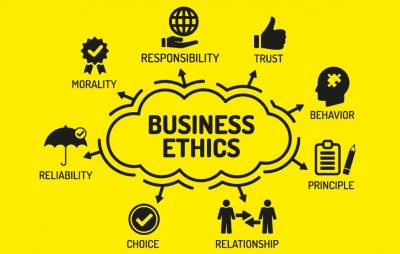
The next chapter is related to the project development, describing the process to implement the prototype (drawings, system schematics, components choice, tests, and results).
7. Project Development
7.1 Introduction
The 'Project Development' chapter describes the development of the EPS project. Firstly, there is a description of the proposed solution to the problem defined previously, followed by a comparison between materials and components to choose the best options for this product. Further, we describe the functionalities of the system and provide the tests and results. Finally, there is a subsection regarding the packaging.
7.2 Proposed Solution
The solution is based on a modular Keyhole Garden, which takes advantage of Vermicomposting to assist in fertilizing the plants. Our product is a smart and modular vermiponic system for residents of city buildings. The modularity of the product allows the vermiponic system to appear in all kinds of sizes and setups. One module can be used privately for example on a balcony of an apartment. A set-up with multiple modules can be used in common areas of apartment buildings such as a rooftop garden or a terrace. Furthermore, the system will also have a rainwater collector with a filter for pollutants in case the water is not safe for the environment. On both sides of the water tank is a tab that allows users to collect water from the tank to use for the plants, this is illustrated in Figure 28. Figure 26 represents the project design for the referred system with an illustration of how it can be used.
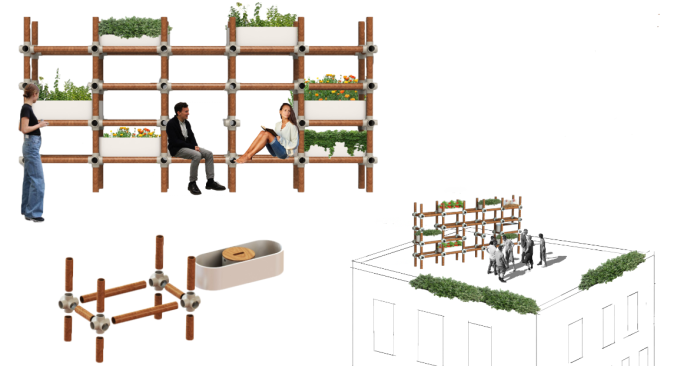
The following image illustrates only one module, which could be used alone in places with less space.
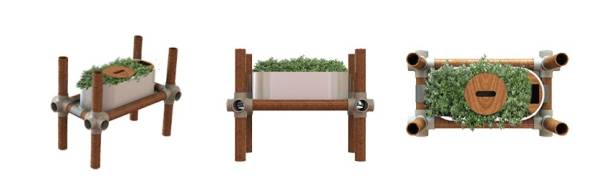
The image below shows a set-up with multiple modules and the different components.
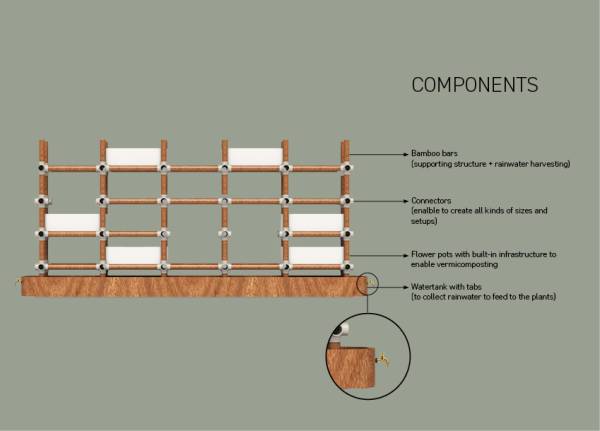
The following image illustrates a cardboard scale model of one module. This gives us an idea of the proportions.
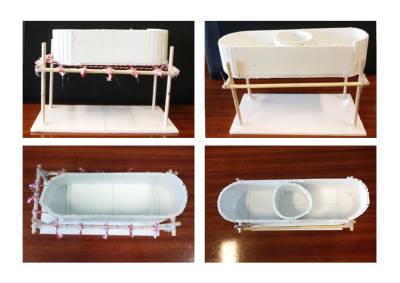
7.2.1 Target Group
To come with a valuable design, we first thought of a target group, presented in the following figure. We decided to focus on people who live in the city, as previously stated in the marketing chapter. More specifically on people living in apartment buildings. They could use their roof to install the modular vermiponics system or just use one module on their balcony. This way the vermiponic system will not only allow them to produce herbs and vegetables sustainably but also will have the power to connect the residents to one and other, as it can function as a meeting spot to come together.
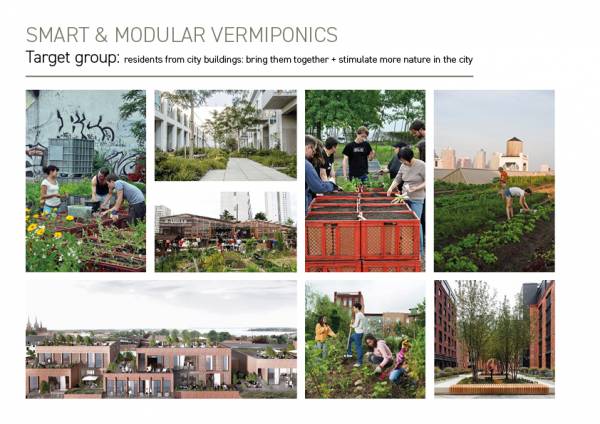
For the design, we looked at existing solutions for inspiration. We decided to go for a natural look and to use organic materials. The shape is mostly determined by the modularity of the product. The most important sources of inspiration are also presented in the mood board below.
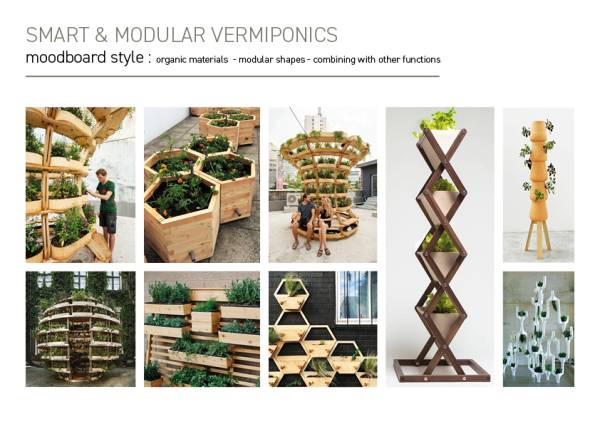
7.2.2 Black Box
To better show the functionality of the product, we drew the black box, as shown in the next image, which is a diagram with the inputs and outputs of the system.
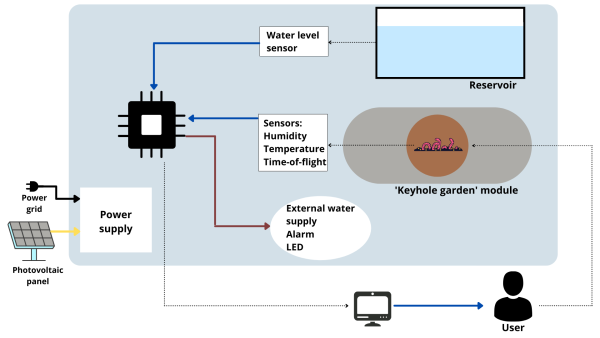
From the functionalities shown in this black box, we tested the humidity, temperature, and time-of-flight sensors. We also used the solar panel and battery to power the system.
7.3 Parts and Materials
This section provides a detailed overview of each part of the system, analysing the options the team went through regarding shape and material.
7.3.1 Bars
For the bars, we decided to use bamboo. We have chosen this material because of various reasons. First of all, it has an esthetically pleasing look. It has a natural appearance which is something we want to strive for in our design. Secondly, bamboo is a material with interesting mechanical properties; its high modulus of elasticity and tensile strength combined with its efficient hollow form make bamboo material with many applications in construction.
We made some calculations on the compressive and tensile strength of bamboo to check if this material was suitable for our application. These calculations are rough estimations because there are 1575 different bamboo species with different structural and mechanical properties. Moreover, these properties can even vary within a single bamboo species, depending on the age, humidity, growing circumstances, and the part of the bamboo stem. This is why we worked with average values. The compressive strength of different bamboo species is mostly between 40 and 80 N/mm². So, we use the minimum value of 40 N /mm² in our calculations. The tensile strength of different bamboo species is mostly around 160 N/mm².
The calculations are presented in the figure below. In these calculations, we assume the flowerpot will weigh approximately 100 kg, based on the density of soil. In reality, this will be less but we consider a safety margin. The results show that the bamboo bars will be strong enough to carry the flowerpot since the safety factor is considerably large for both compressive and tensile stress.
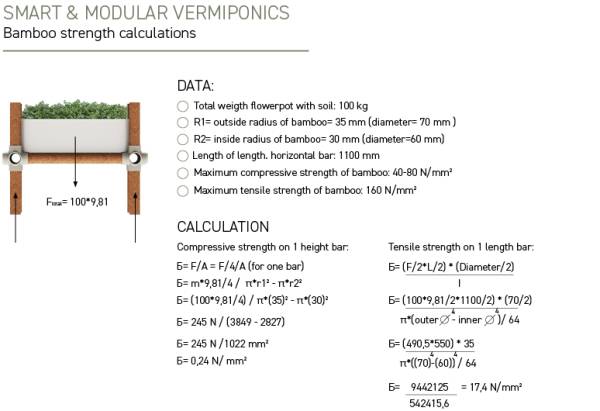
7.3.2 Connectors
After achieving the final design of the structure, it was important to choose the best way to connect the modules. Figures 34 and 35 show the different options the team considered.
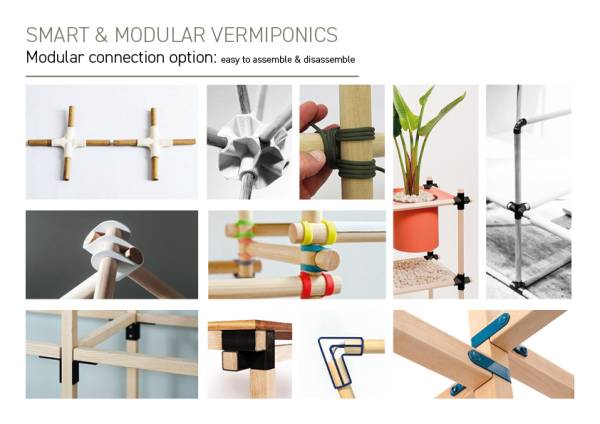

After evaluating different possibilities, the team decided to use ropes for the prototype since it is easily accessible and not too expensive. For the actual product, the following table provides a comparison between a few materials. The table includes a weighing factor. The weighting factor shows that sustainability and easiness to assemble and disassemble are more important properties for our product than the production costs. In other words, Sustainability and easiness to (dis-)assemble are more important for our product than the product costs. Every score will be multiplied by the weighting factor to determine the total score. The scores are scaled from 1 to 10. 1 means 'least desirable for our product' and 10 means 'Most desirable for our product'.
| Weighting factor | Polypropylene | Polyvinyl chloride | Aluminium | Oak | Bamboo | Bioplastics | |
|---|---|---|---|---|---|---|---|
| Sustainability | 2 | 3 | 3 | 6 | 10 | 10 | 7 |
| Easy to assemble & disassemble | 2 | 10 | 10 | 10 | 3 | 4 | 10 |
| Production costs | 1 | 8 | 6 | 8 | 9 | 6 | 5 |
| Durability | 2 | 7 | 7 | 9 | 6 | 6 | 7 |
| Total | 48 | 46 | 58 | 47 | 46 | 53 | |
Properties of the different materials
Polypropylene (PP)
Organic material composed solely of carbon and hydrogen. It has no impact on the environment. Its advantages are: physiologically indifferent, air permeability and low water vapour permeability, non-flammable, odourless, does not absorb water, ease of processing, thermoplastic, it is perfect for the production of products with complex shapes [69].
Polyvinyl chloride (PVC)
Its main benefits are good plastic properties, high mechanical strength, resistance to many solvents. Thanks to the recycling process, which is carried out on a large scale in the industry, PVC is also an environmentally friendly material [70].
Aluminium
Light and plastic material. It is known as the 'green metal' and 'the best eco metal' due to the fact it has a virtually infinite lifespan. It can be recycled repeatedly without losing quality.
Wood
Natural and ecological material. On the other hand under the influence of weather conditions, changes in weather and temperatures, wood changes size, i.e. swell and shrinks [71].
Bamboo
The fastest-growing plant in the world. Some varieties can grow up to 1-2 meters a day or 18 meters in 90 days. Advantages: durable, flexible, lightweight, resistant to moisture and easy to care for - they can be washed with warm water and detergent and do not be afraid that they will soak up water [72].
Bioplastics
Biocomposites (plastics made with a matrix resin — either petroleum-based or renewable and a reinforcement of natural fibres or fillers). Biocomposites do not deviate significantly from traditional plastics and can be processed on the same equipment without major modifications to the injection moulding process. Biocomposites are filled with organic fillers and fibres, which are especially sensitive to high temperatures and shear buildup. Changes in your process (e.g., lower temperatures, slower injection speeds) and tooling (e.g., opening a cooling line, enlarging gates) may be needed to alleviate shear stress and prevent the material from overheating. Although injection speeds might need to be lower for biocomposites, cycle times should remain within an acceptable range because they are being processed at lower temperatures meaning less cooling time is required [73].
Wood-plastic composites feature the benefit of reduced melting temperature, resulting in lower energy costs for producers, and further reducing the product’s environmental impact. Wood-plastic composites may often be used with existing tooling. Wood and plastic each bring their own strengths to a composite material. Plastic enhances the strength and durability of the wood, and wood lends a look and feels too plastic that had always been lacking in older formulations [74].
Biodegradables (plastics that are metabolized into organic bio-mass after use). The vast majority of processing problems with biodegradable plastics stem back to moisture and temperature. Processing biodegradable plastics at above the recommended temperature will cause the material to degrade. And if excess moisture is present, the resulting parts will be brittle, weak and have a reduced shelf life. If all processing recommendations are followed, though, the biodegradable plastic will remain strong and functional. Biodegradable plastics, Terratek® BD and Terratek® Flex are certified compostable according to ASTM D6400 and EN 13432, meaning they will disintegrate within 12 weeks and biodegrade within 180 days in an industrial composting facility [75].
Conclusion regarding the materials
Aluminium scores the highest in our comparison table. This lightweight and strong material can be injection moulded. The best shape would be injection-moulded joints with six cylindrical entrances. The production costs will be efficient because all the connectors are the same and only one mould would be required. The fact that the connectors all have the same shape is also an advantage when the system is being assembled, preventing the user from making mistakes. This material will also be used for the flowerpot.
7.3.3 Supporting Structure
The following figure presents the different supporting structures. The goal of this structure is to help carry the weight of the plant and compost pot.

After evaluating these options, we again decided to use a rope structure for the prototype, for the same reasons as mentioned for the connection options, which are easy accessibility and low costs. For the actual product, we would go for an aluminium plate, as shown in the low corner on the right in the image above. Aluminium has the advantage of being a lightweight material, as well as aesthetically pleasing.

7.3.4 Flowerpot
The following picture illustrates the components of the flowerpot.
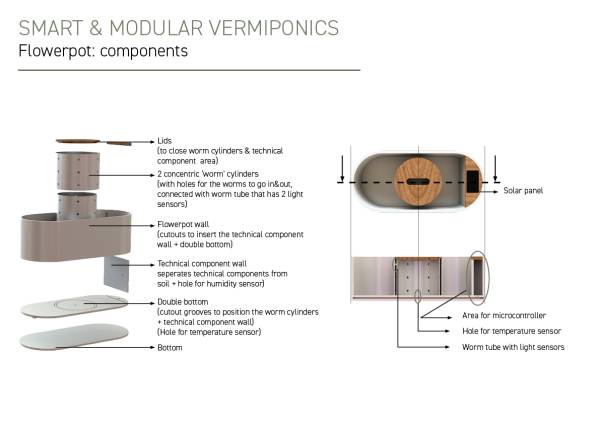
On the right side of the flowerpot, a closed compartment is integrated to protect the technical/electrical components. A solar panel is integrated into the lid of this area. The keyhole garden is made of two concentric cylinders. The two cylinders will be connected through tubes. These ‘worm tubes’ provide a passageway for the worms to go in and out of the composting centre. These tubes will have two integrated time-of-flight distance sensors to detect the movement of the worms. This way the user can track the worms and the direction of their movement.
Furthermore, there are two more sensors integrated into the flowerpot. One is a humidity sensor, which will measure the humidity in the soil. This way the user knows when he has to water the plants. The sensor is placed in a foreseen hole in the partition wall or “the electrical component wall”. This way the distance between the microcontroller and the humidity sensor is minimized. The last sensor in the flowerpot is a temperature sensor. This sensor measures the temperature inside the composting bin. This sensor is connected with the microcontroller through the double bottom. The wires of the sensors will be protected from humidity with a brass pipe.
7.4 Final List of Materials
The following table compiles the chosen materials for the product (more information can be found here). The list of materials for the prototype may also be consulted here.
| Part | Material |
|---|---|
| Bars | Bamboo |
| Connectors | Aluminium |
| Supporting structure | Aluminum |
| Flowerpot | Aluminium |
7.5 Electrical Components
This topic is dedicated to the study of different technical components necessary for the smartification of the product, to make a final decision of the best solution for each constituent.
7.5.1 Micro-controller
| Name | Description | Dimensions (mm x mm) | Price (€) | Supplier |
|---|---|---|---|---|
| Arduino UNO | Processor: ATmega328P Operating voltage: 5 V Input (recommended): 7-12 V Input (limit):6-20 V Digital I/O Pins: 14 PWM Digital I/O Pins: 6 Analog input pins: 6 DC current per I/O pin: 20 mA DC current for 3.3 V pin: 50 mA Flash memory: 32 kB SRAM: 2 kB EEPROM: 1 kB Clock Speed: 16 MHz | 68.6 x 53.4 mm | 17.71 | PTRobotics |
| Arduino Nano 33 IoT | Processor: SAMD21G18A Operating voltage: 3.3 V Flash memory: 256 kB SRAM: 32 kB Clock Speed: 48 MHz Wi-Fi Bluetooth | 18 x 45 | 26.00 | ElectroFun |
| Raspberry Pi 3 Model B | Processor frequency: 1200Mhz Storage: 1Gb Wi-Fi Ethernet USB 2.0 Bluetooth 4.1 Operating voltage: 5.0 V Supports Windows and Linux | 56 x 85 | 39.50 | Aquario |
| ESP32 SparkFun Thing | Dual-core Tensilica LX6 microprocessor Up to 240MHz clock frequency 520kB internal SRAM Integrated 802.11 BGN WiFi transceiver Integrated dual-mode Bluetooth (classic and BLE) 2.2 to 3.6V operating range 2.5 µA deep sleep current 28 GPIO 10-electrode capacitive touch support Hardware accelerated encryption (AES, SHA2, ECC, RSA-4096) 4MB Flash memory Integrated LiPo Battery Charger | 26.0 x 59.5 | 24.90 | BotnRoll |
The micro-controller must be of low consumption, including a Wi-Fi connection module. Therefore, the ESP32 is the most appropriate option for the project. As a battery will be needed to power the system, the ESP32 with a battery charging system integrated is the best controller for the project. Consequently, the rechargeable lithium battery recommended using with this micro-controller will be used:
Li-Ion Battery 18650
- Specifications: 3.7 V; 2200 mAh; Ø18x65mm
- Provider: BotnRoll
7.5.2 Sensors
Water Level Sensor
This sensor determines the water level of the water tank. It will be placed on the rainwater collector to decide if it has enough water to water the system or if it is necessary to use the building's water supply. Table 25 compares different options available on the market for this sensor.
| Name | Description | Specifications | Dimensions | Price (€) | Supplier |
|---|---|---|---|---|---|
| Non contact water/liquid level sensor XKC-Y25-T12V | Advanced signal processing technology High-speed operation capacity No contact with liquid Easy to use and easy to install Equipped with an interface adapter that makes it compatible with DFRobot “Gravity” interface 4 levels of sensitivity | Operating Voltage (InVCC): DC 5 ~ 24 V Current consumption: 5 mA Output voltage (high level): InVCC Output voltage (low level): 0 V Response time: 500 ms Operating Temperature: 0 ~ 105 ℃ Humidity: 5% ~ 100% Material: ABS Waterproof performance: IP67 | 28 x 28 mm | 12.30 | ElectroFun |
| INOX Water level sensor | Buoy-like shape and the material used increase its application possibilities. It is generally used to connect water pumps to liquid reservoirs, keeping the container always full, and the sensor, through the Arduino, is responsible for deactivating the pump in order to save energy and increase the life of the engine. | Material: stainless steel Commutation voltage: max 220 V DC Commutation current: max 1.5 A Transport current: max 3.0 A | Cable length: 30 cm Floating body length: 24 cm | 14.90 | ElectroFun |
| 10W Liquid level sensor | The Liquid Level Sensor can be used to detect the level of liquid in a tank. You can activate a pump, an indicator, an alarm or another device. | Material: plastic Switch power (Max): 10 W Current (Max): 0.5 A AC Electric resistance: AC 1500 V / I min Temperature: -20 ºC ~ + 80 ºC | Cable length: 40 cm Float length: 85 mm | 6.20 | ElectroFun |
The '10W Liquid Level Sensor' is small and relatively cheap compared to the other options, it works on a large temperature range and we think it is a good option for the product.
Temperature sensor
The temperature sensor will monitor the worms' environment temperature. If it detects a high temperature, the worms usually do not adapt to it so an alarm will sound. The following table compares a few options for temperature measurement.
| Name | Description | Specifications | Dimensions | Price (€) | Supplier |
|---|---|---|---|---|---|
| Waterproof temperature sensor DS18B20 | Capable of measuring temperature of humid environments, including underwater | Chip: DS18B20 Operating voltage: 3-5.5 V Measurement range: -55 ºC to +125 ºC Accuracy: ±0.5 °C between -10 ºC and +85 ºC 12-bits measurements (configurable) Stainless steel tip | Tip: 6 x 50 mm Cable length: 100 cm | 3.70 | Mauser |
| PT100 Temperature sensor | Thermistor | Range: -50ºC ~ 350ºC 0 ºC resistance: 100 Ω | Φ3 mm x 10 mm | 11.87 | ElectroFun |
The temperature sensor should be able to work in humid environments given the features of the product, therefore, the best option is the Waterproof Temperature Sensor DS18B20.
Humidity sensor
Although worms live in a humid environment, too much humidity may affect them negatively, so it is important to track soil humidity. Table 27 compares humidity sensors available on the market.
| Name | Description | Specifications | Price (€) | Supplier |
|---|---|---|---|---|
| Seeed Capacitive humidity sensor | Corrosion resistant Soil humidity sensor based on capacitance changes In comparison with resistive sensors, these don't need direct exposition of electrodes | Integrated amplifier | 8.49 | ElectroFun |
| M5Stack Earth soil humidity sensor | The probes act together as a variable resistance. The higher the humidity in the soil, the better the conductivity between the two, so that the sensor results in less resistance and higher SIG output. | Adjustable potenciometer Analogical and digital output | 4.95 | ElectroFun |
| ITEAD humidity sensor | Used for measuring soil humidity Plug and play | Adjustable potenciometer Analogical and digital output Operating voltage: 3.3 V or 5 V DC | 4.78 | ElectroFun |
| Humidity sensor | Detects soil moisture variations, when it is dry the output turns to High and when it is humid it turns to Low | Operating voltage: 3.3 - 5.0 V Adjustable sensitivity via potenciometer Analogical and digital output LED for voltage (red) LED for digital output (green) Comparator LM393 PCB dimensions: 3.0 x 1.5 cm Probe: 6 x 2 cm Cable length: 21 cm | 3.30 | ElectroFun |
The humidity sensor should have high corrosion resistance, as the 'Seeed Capacitive humidity sensor' is capacitive, it is the most resistant, and the choice for the project.
Time-of-flight sensor
The time-of-flight distance sensor will work as a tracking device for the worms. To find out the direction of movement, two of these sensors will be necessary to put on the tubes the worms travel through. As recommended by the supervisors, the chosen sensor is: Time-of-flight sensor.
7.6 Power
7.6.1 Power Budget
The power budget is essential to choose the right photovoltaic panel for the system. Therefore, we will consider the worst-case scenario.
An ESP32 has a few determined power consumption values, as seen in Table 28.
| ESP32 mode | Consumption |
|---|---|
| Deepsleep | 7 µA |
| Lightsleep | 1 mA |
| Normal (240 MHz) | 50 mA |
| Reduced clock (3 MHz) | 3,8 mA |
| WiFi operation | 80-190 mA |
Specifically, for ESP32 SparkFun Thing:
| ESP32 mode | Consumption (mA) |
|---|---|
| Reference | 41 |
| Lightsleep | 5.67 |
| Deep-Sleep | 4.43 |
| Hibernation | 4.43 |
| WiFi operation (mean) | 115 |
Considering the worst-case scenario:
- I = 0.190 A
- U = 5 V
- P = I x U = 0.95 W
Further, we will analyse different options for the photovoltaic panel.
7.6.2 Photovoltaic panel
The following table has three different options for the photovoltaic panel.
| Name | Price (€) | Supplier |
|---|---|---|
| Photovoltaic Panel Poli-crystalline 12V 5W - Cellevia Power CL-SM5P | 10.35 | Mauser |
| Photovoltaic Panel Poli-crystalline 10W / 12V - Cellevia Power CL-SM10P | 15.20 | Mauser |
| Photovoltaic Panel Silicon Mono-crystalline 20W / 12 V | 22.99 | Castro Electronica |
Based on the calculations for the power needed, we concluded that the first option is enough for our project.
7.7 Final List of Components
Finally, after comparing all the different options available, the following table compiles the chosen components and suppliers for the project.
| Functionality | Name | Quantity | Price (€) | Supplier |
|---|---|---|---|---|
| Micro-controller | ESP32 SparkFun Thing | 1 | 24.90 | BotnRoll |
| Water level sensor | 10W Liquid Level Sensor | 1 | 6.20 | ElectroFun |
| Temperature sensor | Waterproof temperature sensor DS18B20 | 1 | 3.70 | Mauser |
| Humidity sensor | Seeed Capacitive humidity sensor | 1 | 8.49 | ElectroFun |
| Time-of-flight distance sensor | Sensor VL53L0X | 2 | 14.90 | BotnRoll |
| Battery | Li-Ion Battery 18650 | 1 | 3.90 | BotnRoll |
| Photovoltaic panel | Photovoltaic Panel Poli-crystalline 12V 5W | 1 | 10.35 | Mauser |
| Total | 72.44 |
7.8 Packaging
The choice for the packaging was an immediate one, given the nature and purpose of our product. The packaging material will be cardboard. This decision was based on the fact that this material can be composted [78], as long as it is uncoated with no heavy dyes, broken down, free from tape or labels [79]. Therefore, the cardboard can have multiple destinations:
- Wormify's composting basket (the process is described in the user manual);
- Reusing for storage, parcels, etc.;
- Recycling.
There are two common forms of cardboard packaging - corrugated cardboard and paperboard. The first is made of multiple corrugated and flat layers of cardboard and is the material for boxes. Corrugated cardboard is thick, durable, and strong. The second option is made of recycled cardboard and it is similar to paper but thicker. It is usually grey, used in cereal boxes, shoe boxes, etc [80]. Figure 39 shows the two options of cardboard - on top, there is the corrugated and on the bottom, there is the paperboard.
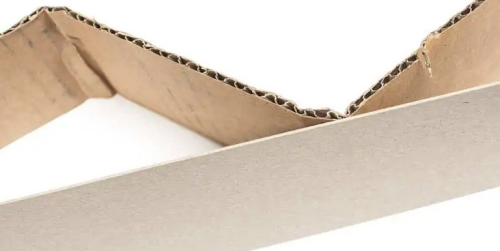
As the product is quite heavy and the packaging should sustain its weight, corrugated cardboard is the best option. This packaging offers transport safety, storage efficiency, less damage, retail presentation, and it is easy to assemble.
The team proceeded to research for possible partners and found DS Smith. They offer different solutions, which can be consulted on their website, but they also provide personalized offers such as the one we require for Wormify. Their bulk packaging represented in figure 40 is an interesting option because it can have double or triple walls made from natural and fully recyclable and compostable ingredients. This is a cost-effective packing option as it significantly reduces labour and shipping costs. It can be produced to our specific requirements, with a professional image [82].
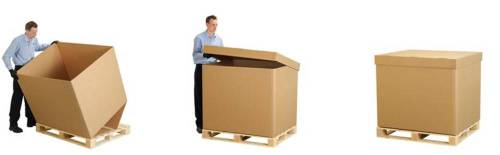
Our packaging design is presented below in Figure 41. The lowest level of the cardboard box (for one module) contains the aluminium plate, the flowerpot, the four height bars, and two length bars. The second level of the box contains two width bars, four connectors, and two aluminium connectors. The box is square-shaped which is good for efficient storage and transport. The cardboard box will be delivered to the user with a bag of potting soil and a bag with the worms.
Figure 42 illustrates the packaging solution with the soil and the worms.
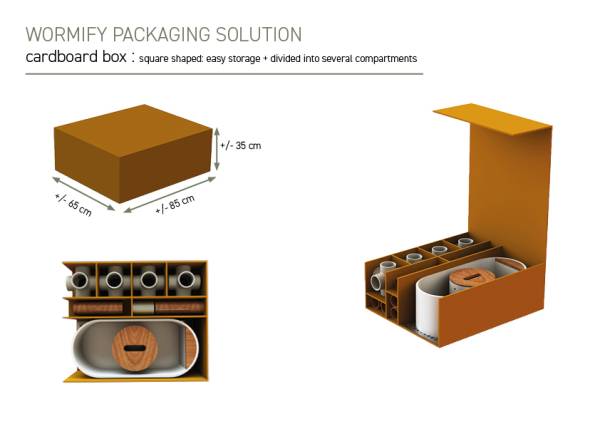
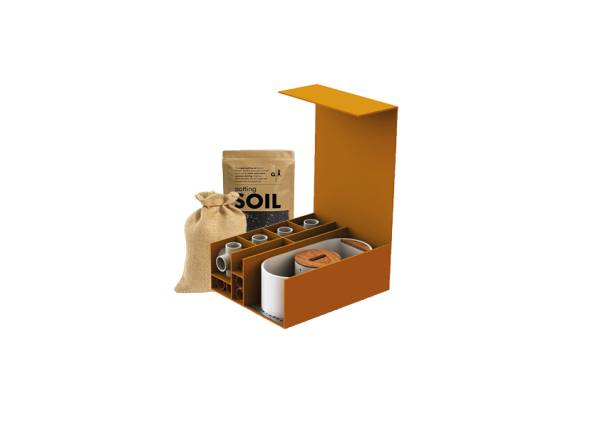
7.9 Functionalities
The correct and effective functioning of the system depends on the following features:
- Keep track of the worms' movement through the tubes with time-of-flight sensors, which detect the direction of their movement and let us know how many worms are inside and outside the composting basket. This will help the user check if the movement is regular and if it is not, he should add some worms to the environment. Later on, a daily report will be added to the application so the user can verify this easily.
- Alert if temperature and/or humidity are outside specified limits - the temperature and soil moisture sensors allow us to continuous verify if the temperature inside the composting bin and the humidity in the soil are the desirable ones. If the temperature rises above the given limit (with a margin so the user has some margin to work with), a notification will appear on the app. When the humidity is too low, the user should water the plants.
- Use renewable energy sources by implementing solar panels in each module.
- Use/collect rainwater when available, such water can be used by the user to water the plants.
- Be user-friendly (minimal maintenance) - the user is provided with a manual that prevents them from making mistakes and getting the best out of the system without having to do much.
7.10 Tests and Results
In this part, the types of simulation that were performed for Wormify are presented. First of all, we built a 1:1 scale model of one module. The prototype is a simplified version of what the actual product is supposed to be. This means that dimensions are smaller and materials are cheaper and more accessible versions of the ideal ones.
The team followed the traditional protocol to collect the worms from the land. Firstly, a bucket was inserted into the ground. Then, a layer of food waste was added, followed by a layer of dry leaves and shredded paper. Finally, the team inserted the lid on top to prevent other animals from entering the composting basket. After five days, we were able to remove the bucket from the ground and get the worms that were attracted to the food waste.
The supporting structure of the prototype was first built with ropes as connectors for the wood used in replacement of the bamboo in the actual product. The simulation did not go as predicted because of the wheels used for transportation, as they made the legs unsteady. Thus, the team improvised the connections with wood screws, but this will not be a problem with the actual product as it does not require wheels and the shape of the connector prevents the legs from sliding. Figure 43 shows both options.
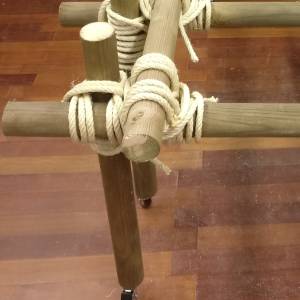 (a) Connection with rope (a) Connection with rope | 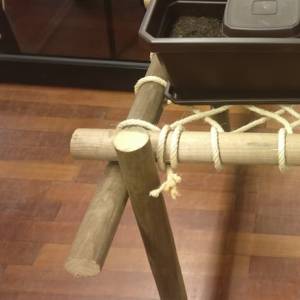 (b) Connection with wood screws (b) Connection with wood screws |
The most important goal of the prototype is to illustrate the working of the flowerpot with the integrated keyhole garden. In the composting bin, we put a layer of cardboard in the small centre basket and a layer of food waste. We started adding the worms, and then a layer of shredded cardboard and leaves. The soil was inserted around the basket in the centre. We planted two types of herbs in our flowerpot: mint and basil. The plants looked healthy and continued to grow for the two weeks we supervised them. Figure 44 presents our prototype.

Figure 45 illustrates the connections between the sensors and the ESP32 to smartify the system.
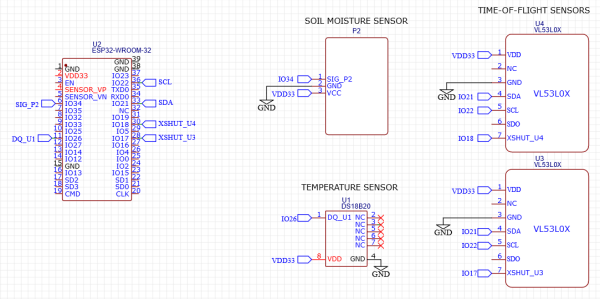
Figure 46 illustrates the connections made to power the system through the solar panel and lithium battery.
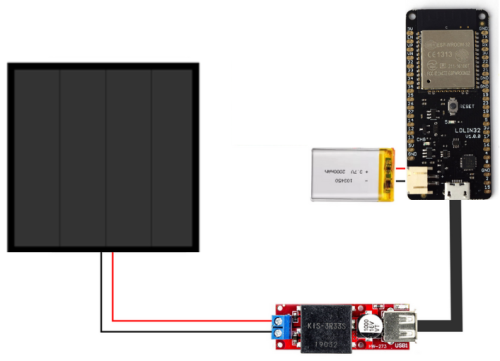
7.10.1 Code
Using Arduino IDE, the team programmed the ESP32 to make a connection to the internet and to read the data from the sensors.
First, we included the necessary libraries and defined the network credentials and server domain, as shown in Figure 47.
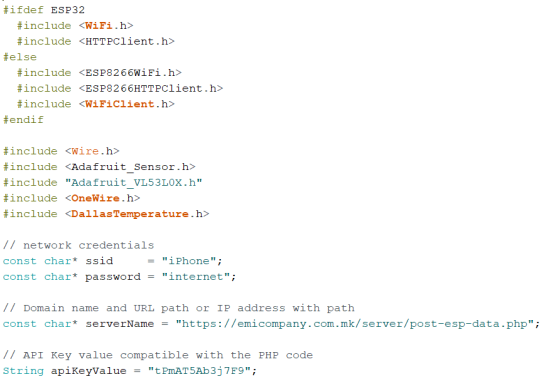
The code presented in Figure 48 establishes the pins to which the temperature and soil moisture sensors are connected and creates the necessary variables to read the data.
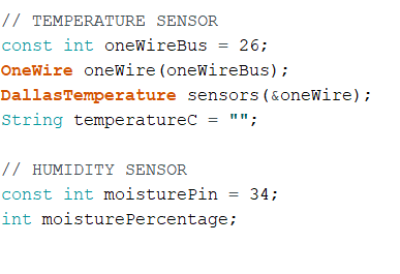
For the time-of-flight sensors, multiple procedures need to be conducted to detect the direction of the worms' movement. The first step was to define the address and the shutdown pins for each sensor - this is very important because the ESP32 only has one SCL and one SDA connections, thus the two sensors are connected to the same pins and they are differentiated by the address and their shutdown pins (code on the right side of Figure 49. The second step was defining the function “setup()” (left side of Figure 49. This function activates and assigns the addresses defined previously to each sensor. To do so, it needs to reset the two sensors, unreset those, and then alternate on resetting them to establish the address of the other sensor.
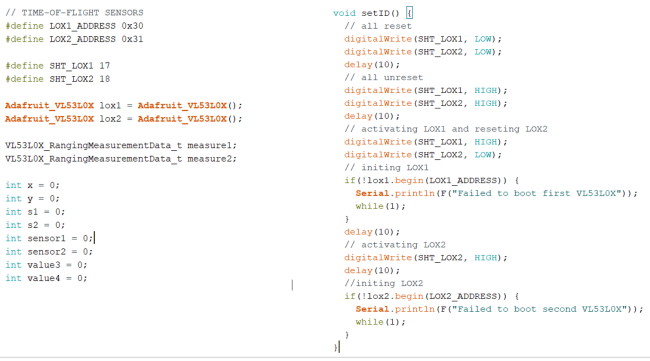
Finally, regarding the time-of-flight sensors, it is necessary to read the data and define the direction of the movement based on which sensor is activated first. This procedure is completed within the function “read_dual_sensors()” presented in Figure 50 and explained in the flowchart in Figure 51.
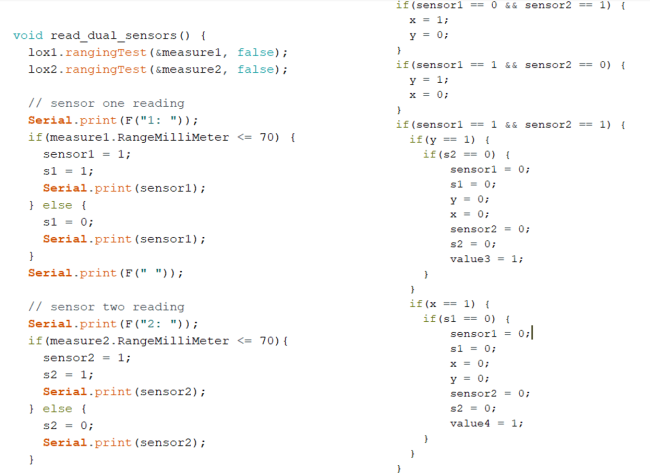
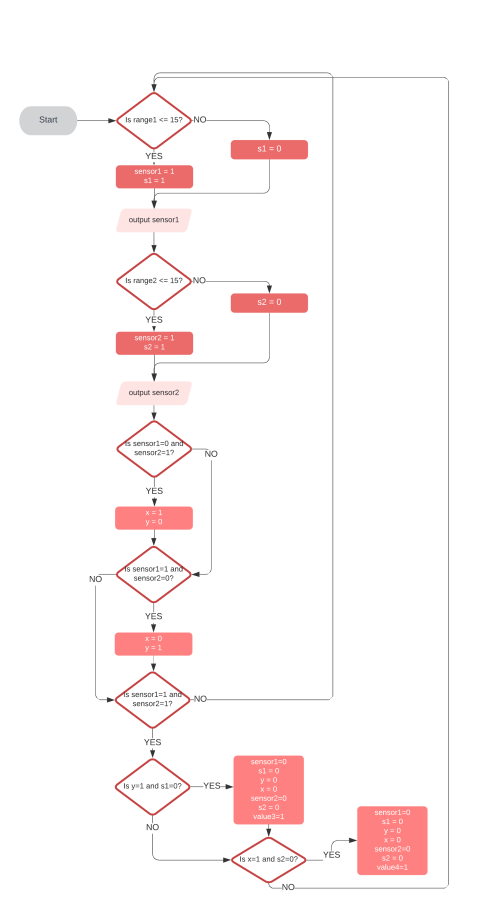
Finally, the “loop()” function presented in Figure 52 is a continuous loop that reads the values from the sensors every four seconds and sends these to the server.
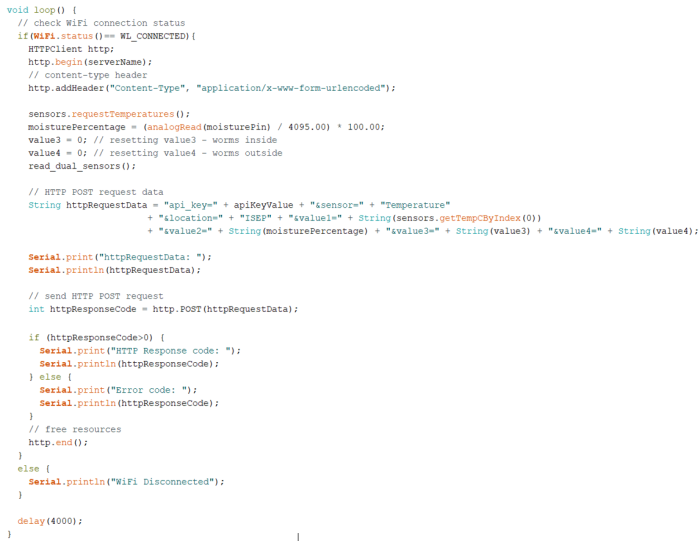
7.10.2 Website
The data collected from the previous code is sent to Wormify's website. The information displayed on the website is shown in real-time and allows the user to monitor the system remotely. Figures 53 and 54 show,respectively, the pages to create a new account and to sign in to an already existing account. Figure 55 exhibits the layout and information displayed on Wormify’s website. Wormify


7.11 Summary
The team went through a deep analysis of components, parts, and materials which allowed us to create a product that not only answers the problem described in the Introduction but that also has the potential to create an environment that unites residents from a city building. Once this target audience was defined, it was easier to view the whole concept on a more defined level. The analysis of the different materials was carefully done, with evaluations of each material to choose the most sustainable options. Aluminium and bamboo are the predominant materials in this product because of their lifespan and easy recyclability. Calculations of strength, dimensions, weight capacity were carried to ensure the safety and performance of the product.
The prototype was implemented and is working as best as it should be and the presented conditions. Wormify only depends on the user for watering the plants, providing the food waste, and occasionally one will also need to remove the excess liquid produced, which will be stored on the bottom of the product. Several tests were conducted to prove the functionality of the product. The worms started composting the food waste at a regular pace, and we could see them travelling from and to the composting centre through the holes when we were mixing the composting waste.
To conclude the project development chapter, the team considers the construction of this proof-of-concept was successful. Although some difficulties were met during the semester, the dedication of each member made it possible to build Wormify and to expand our knowledge. Wormify was created following sustainability measures and a rigid code of ethics.
The following chapter is the conclusion, contemplating a discussion and future work. Conclusions and prospective the team drew during this project will be discussed as well as aspects related to the product, limitations, requirements, and results obtained.
8. Conclusions
8.1 Discussion
The main objective of this project was to develop an alternative and sustainable way to produce food. The team fully committed to this project and succeeded in creating a smart and modular vermiponic system, specifically aimed at residents of apartment buildings. We succeeded in reaching our goal by combining our strengths in different areas such as project management, marketing, sustainability, ethics and product development.
Starting from the general theme ‘smartification of everyday objects', we developed our brand ‘Wormify’. Our solution is based on a modular, easily movable Keyhole Garden, which takes advantage of vermicomposting to assist in fertilizing the plants. A temperature sensor, a humidity sensor and light sensors are integrated into the design to assure optimal, environmental circumstances for vermicomposting and plant growth. Furthermore, the system will also have a rainwater collector with a filter for pollutants in case the water is not safe for the environment. The user is notified by the website/app if he needs to intervene in the system. The product is powered by an integrated solar panel and battery.
Modularity is one of the features the team stuck to from the beginning because it is avidly valued by customers. The modularity of the product allows the system to appear in all kinds of sizes and setups, depending on the space available - it can be used in a personal space or on a shared ground with multiple modules.
The vermiponic system is packed in a simple, corrugated cardboard box. The cardboard is compostable and can be reused to facilitate the composting process. The box is square-shaped which is good for efficient storage and transport. The cardboard box will be delivered to the user with a bag of potting soil and a bag with the worms. An actual prototype was built to show the proportions and functionality of our design.
8.2 Future Development
The product can be improved on different aspects. For example, there is a big opportunity for improvement in terms of the rainwater collecting system. A possible improvement could be to include a pumping system. In the current design, the user has to water the plants himself. He will have to fill a watering can with water from the rainwater collector and then administer it to the plants. If a pumping system were provided, it would save effort for the user. To develop an efficient pumping system, that can be adapted according to the number of modules, specific knowledge and research are required.
Moreover, more research needs to be conducted regarding the worm tracking system, as it is still rudimentary. Aspects like multiple worms passing at the same time need to be considered.
As for the website and app, improvements can also be made. We only developed a basic interface to illustrate the idea. The final app should have multiple features. More specifically, collaboration features. As said before, our product is specifically designed for residents of apartment buildings and offers the opportunity to connect the residents as they can gather around the vermiponic garden as well as work together to grow the plants. The app can facilitate that collaboration with certain features. For example, the possibility to create groups and show the residents if someone watered the plants or provided kitchen waste for the composting process. Even a social media aspect or game aspect could be integrated, that allows people to post pictures / gives likes to certain actions/ deserve points. This will depend on marketing research that finds out what’s most suitable for our target group.
Finally, it would be interesting to implement microspheres of kefir water and alginate in the system, because worms like kefir and it can also act as a biofertilizer. Kefir is a mildly acidic fermented milk. It is naturally produced by the addition of lactic acid bacteria and yeasts to milk. Regarding mineral content, kefir is a good source of calcium and magnesium. Calcium is important because worms need a continuous supply of this element. Therefore, it would be interesting to produce microspheres containing kefir, using alginate, a natural polymer that crosslinks in the presence of divalent cations such as calcium [84].
To conclude there is also room for expansion of our product. This mainly refers to the launch of different product lines, each with a different approach. We could design simpler versions that are more cheap or more advanced versions that have more features such as a pumping system, as mentioned before.